


Page 691 - Manufacturing Engineering and Technology - Kalpakjian, Serope : Schmid, Steven R.
P. 691
2      Chapter 24  Machining Processes: Milling, Broaching, Sawing, Filing, and Gear Manufacturing

                                   24.2.8 Milling Machines
                                   Because they are capable of performing a variety of cutting operations, milling ma-
                                   chines are among the most versatile and useful machine tools. The first milling ma-
                                   chine was built in 182.0 by Eli Whitney (1765-1825). A wide selection of milling
                                   machines with numerous features is now available. The features of typical standard
                                   milling machines are described next. Note, however, that many of these machines
                                   and operations are now being replaced with computer controls and machining cen-
                                   ters. Inexpensive, manually controlled machines are still widely used, especially for
                                   small production runs.
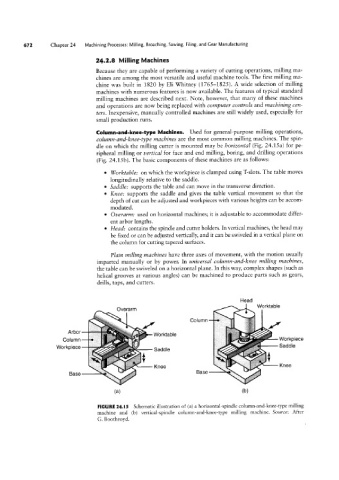
                                   Column-and-knee-type Machines.  Used for general-purpose milling operations,
                                   column-and-knee-type machines are the most common milling machines. The spin-
                                   dle on which the milling cutter is mounted may be horizontal (Fig. 24.l5a) for pe-
                                   ripheral milling or vertical for face and end milling, boring, and drilling operations
                                   (Fig. 24.15 b). The basic components of these machines are as follows:

                                      ° Worktable: on which the workpiece is clamped using T-slots. The table moves
                                        longitudinally relative to the saddle.
                                      ° Saddle: supports the table and can move in the transverse direction.
                                      ° Knee: supports the saddle and gives the table vertical movement so that the
                                        depth of cut can be adjusted and workpieces with various heights can be accom-
                                   "`”‘
                                        modated.
                                      ° O1/erarm: used on horizontal machines; it is adjustable to accommodate differ-
                                                                              tl»e
                                        ent arbor lengths.
                     W°"<P‘@°e
                                      ° Head: contains the spindle and cutter holders. In vertical machines, the head may
                                        be fixed or can be adjusted vertically, and it can be swiveled in a vertical plane on
                                        the column for cutting tapered surfaces.

                                        Plain milling machines have three axes of movement, with the motion usually
                                   imparted manually or by power. In universal column-and-knee milling machines,
                                   the table can be swiveled on a horizontal plane. In this way, complex shapes (such as
                                   helical grooves at various angles) can be machined to produce parts such as gears,
                                   drills, taps, and cutters.
                                          Overarm                                /
                                     .. .
                                                                                        d
                                                                                     H
                                                                                      ea
                                                                                           Worktable
                         Arbor  °%                                  C°'Um“
                                                       Knee   5”

                         Base                          saddie         BHSQ    ~    Vppy            Saddle
                                                                            if>Lii1;f

                       C                           ».i~~  W°'k*ab'e          | »
                        °'Umf1    1                                               li i             Wolkplece
                                                                                      'Wi'
                                  if
                                                                                                   Knee
                                        ..


                                         (H)                                      ,»,,`  (D)
                                   FIGURE 24.l5  Schematic illustration of (al a horizontal-spindle column-and-knee-type milling
                                   machine and  (b) vertical-spindle column-and-knee-type milling machine. Source: After
                                   G. Boothroyd.

