


Page 694 - Manufacturing Engineering and Technology - Kalpakjian, Serope : Schmid, Steven R.
P. 694
Section 24.4  Broaching and Broachmg Machmes

               Shaping.  Machining by shaping is basically the same as by planing, except that (a) it
               is the tool, and not the workpiece, that travels and (b) Workpieces are smaller, typically
               less than 1  >< 2 m of surface area. In a horizontal shaper, the cutting tool travels back
               and forth along a straight path. The tool is attached to the tool head, which is mounted
               on the ram. The ram has a reciprocating motion, In most machines, cutting is done dur-
               ing the forward movement of the ram (push cut); in others, it is done during the return
               stroke of the ram (draw cut). Vertical shapers (slotters) are used to machine notches,
               keyways, and dies. Because of lovv production rates, only special-purpose shapers
               (such as gear shapers, Section 24.7.2) are in common use today.


               24.4    Broaching and Broaching Machines


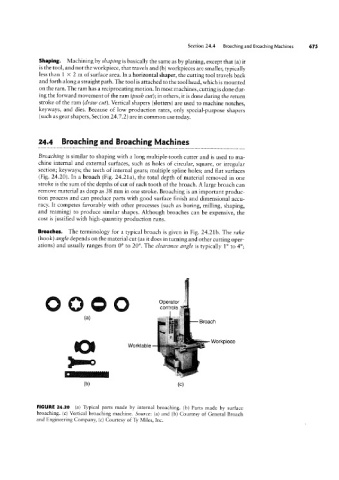
               Broaching is similar to shaping with a long multiple-tooth cutter and is used to ma-
               chine internal and external surfaces, such as holes of circular, square, or irregular
               section; keyvvays; the teeth of internal gears; multiple spline holes; and flat surfaces
               (Fig. 24.20). In a broach (Fig. 24.21a), the total depth of material removed in one
               stroke is the sum of the depths of cut of each tooth of the broach. A large broach can
               remove material as deep as 38 mm in one stroke. Broaching is an important produc-
               tion process and can produce parts with good surface finish and dimensional accu-
               racy. It competes favorably with other processes (such as boring, milling, shaping,
               and reaming) to produce similar shapes. Although broaches can be expensive, the
              cost is justified with high-quantity production runs.

               Broaches.  The terminology for a typical broach is given in Fig. 24.21b. The rake
               (hook) angle depends on the material cut (as it does in turning and other cutting oper-
              ations) and usually ranges from 0° to 20°. The clearance angle is typically 1° to 4°;


                                                         Operator
                                                         controls

                                                                      - Broach


                                                                           Workpiece
                                              Worktable


                              (D)                              (C)


              FIGURE 24.20  (a) Typical parts made by internal broaching. (b) Parts made by surface
              broaching. (c) Vertical broaching machine. Source: (a) and (b) Courtesy of General Broach
              and Engineering Company, (c) Courtesy of Ty Miles, Inc.

