


Page 695 - Manufacturing Engineering and Technology - Kalpakjian, Serope : Schmid, Steven R.
P. 695
Chapter 24  Machining Processes: Milling, Broaching, Sawing, Filing, and Gear Manufacturing

                                                                  hook angle _X  Pi1Cl'1  /-_ an  d  Clearance angle
                                                                     Fiake or
                                                                                          |_
                               ,orer
                                                                          /V
                                                                                        <-
                             Chip gullet
                                                                                                 Back-off or
                                  ~'  ,liii  ""
                                                                  Tooth
                          ,_,_                                   depth                             T
                        __  f ;a,_,e                                        <1
                                                  Workpiece                                  Root radius
                                          (H)                                         (D)

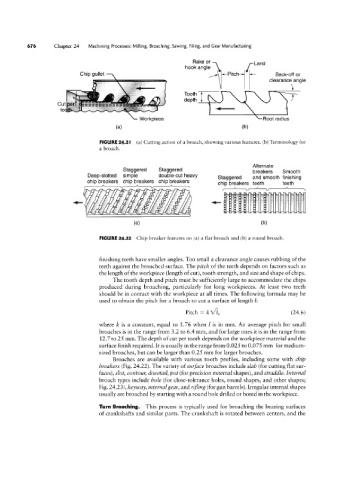
                                    FIGURE 24.2l  (a) Cutting action of a broach, showing various features. (b) Terminology for
                                    a broach.


                                                                                         Alternate
                                            eteggelee    Sleggered                        breakers  Smooth
                                Deep-slotted  simple     double-cut heavy    staggered   ehd Smooth hhiehihe
                                chip breakers  chip breakers chip breakers   Chip breakers teeth    teeth

                               K   E.  rw,,  2  e l   V  ,ee _  1- -   N       I   _  _   W   A   \/  A    \


                                                la)                                         (D)


                                    FIGURE 24.22  Chip breaker features on (a) a flat broach and (b) a round broach.


                                    finishing teeth have smaller angles. Too small a clearance angle causes rubbing of the
                                    teeth against the broached surface. The pitch of the teeth depends on factors such as
                                    the length of the workpiece (length of cut), tooth strength, and size and shape of chips.
                                         The tooth depth and pitch must be sufficiently large to accommodate the chips
                                    produced during broaching, particularly for long workpieces. At least two teeth
                                    should be in contact with the workpiece at all times. The following formula may be
                                    used to obtain the pitch for a broach to cut a surface of length l:
                                                                  Pitch = /QW,                         (24.6)
                                    where le is a constant, equal to 1.76 when l is in mm. An average pitch for small
                                    broaches is in the range from 3.2 to 6.4 mm, and for large ones it is in the range from
                                    12.7 to 25 mm. The depth of cut per tooth depends on the workpiece material and the
                                    surface finish required. It is usually in the range from 0.025 to 0.075 mm for medium-
                                    sized broaches, but can be larger than 0.25 mm for larger broaches.
                                         Broaches are available with various tooth profiles, including some with chip
                                    breakers (Fig. 24.22). The variety of surface broaches include slab (for cutting flat sur-
                                    faces), slot, contour; dovetail, pot (for precision external shapes), and straddle. Internal
                                    broach types include /role (for close-tolerance holes, round shapes, and other shapes;
                                    Fig. 24.23), ke;/way, internal gear, and rifling (for gun barrels). Irregular internal shapes
                                    usually are broached by starting with a round hole drilled or bored in the workpiece.
                                    Turn Broaching.  This process is typically used for broaching the bearing surfaces
                                    of crankshafts and similar parts. The crankshaft is rotated between centers, and the

