


Page 701 - Manufacturing Engineering and Technology - Kalpakjian, Serope : Schmid, Steven R.
P. 701
82      Chapter 24  Machining Processes: Milling, Broaching, Sawing, Filing, and Gear Manufacturing


                                                               %


                                         Addeiwdum


                                                  Clearance  Fmet
                                                            radius  D6del'\dUl'T1
                                                                   ClrC|€   Clearance
                                                                            circle

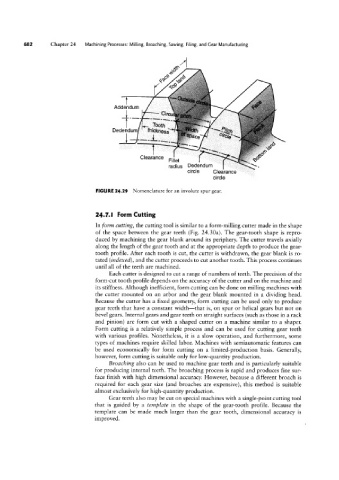
                                   FIGURE 24.29  Nomenclature for an involute spur gear.


                                   24.7.| Form Cutting

                                   In form cutting, the cutting tool is similar to a form-milling cutter made in the shape
                                   of the space between the gear teeth (Fig. 24.3Oa). The gear-tooth shape is repro-
                                   duced by machining the gear blank around its periphery. The cutter travels axially
                                   along the length of the gear tooth and at the appropriate depth to produce the gear-
                                  tooth profile. After each tooth is cut, the cutter is withdrawn, the gear blank is ro-
                                  tated (indexed), and the cutter proceeds to cut another tooth. This process continues
                                   until all of the teeth are machined.
                                       Each cutter is designed to cut a range of numbers of teeth. The precision of the
                                  form-cut tooth profile depends on the accuracy of the cutter and on the machine and
                                  its stiffness. Although inefficient, form cutting can be done on milling machines with
                                  the cutter mounted on an arbor and the gear blank mounted in a dividing head.
                                  Because the cutter has a fixed geometry, form cutting can be used only to produce
                                  gear teeth that have a constant width-that is, on spur or helical gears but not on
                                  bevel gears. Internal gears and gear teeth on straight surfaces (such as those in a rack
                                  and pinion) are form cut with a shaped cutter on a machine similar to a shaper.
                                  Form cutting is a relatively simple process and can be used for cutting gear teeth
                                  with various profiles. Nonetheless, it is a slow operation, and furthermore, some
                                  types of machines require skilled labor. Machines with semiautomatic features can
                                  be used economically for form cutting on a limited-production basis. Generally,
                                  however, form cutting is suitable only for low-quantity production.
                                       Broaclaing also can be used to machine gear teeth and is particularly suitable
                                  for producing internal teeth. The broaching process is rapid and produces fine sur-
                                  face finish with high dimensional accuracy. However, because a different broach is
                                  required for each gear size (and broaches are expensive), this method is suitable
                                  almost exclusively for high-quantity production.
                                       Gear teeth also may be cut on special machines with a single-point cutting tool
                                  that is guided by a template in the shape of the gear-tooth profile. Because the
                                  template can be made much larger than the gear tooth, dimensional accuracy is
                                  improved.

