


Page 685 - Manufacturing Engineering and Technology - Kalpakjian, Serope : Schmid, Steven R.
P. 685
666      Chapter 24  Machining Processes: Milling, Broaching, Sawing, Filing, and Gear Manufacturing
                                          End cutting-edge angle-\                      Peripheral' relief
                                                            u r
                                                                                        (radial relief)
                                                   _
                                                             /. N
                                                           ' Corner
                                                                angle
                                              End relief         _   _
                                          Axial rake, +


                                                                       rake, -
                                            (axial relief)             Radial ea
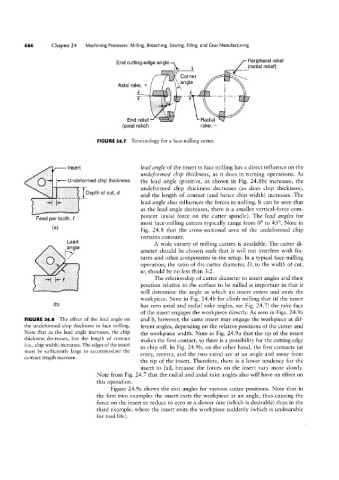
                                   FIGURE 24.7 Terminology for a face-milling cutter.


             _           Insert                   lead angle of the insert in face milling has a direct influence on the
                                                  andefowned chip thickness, as it does in turning operations. As
            V- Undeformed chip thickness          the lead angle (positive, as shown in Fig. 24.8b) increases, the
                                                  undeformed chip thickness decreases (as does chip thickness),
                               Depth of cut, d
                                                  and the length of contact (and hence chip width) increases. The
                                                  lead angle also influences the forces in milling. It can be seen that
                                                  as the lead angle decreases, there is a smaller vertical-force com-
                                                  ponent (axial force on the cutter spindle). The lead angles for
              Feed per tooth, f
                                                  most face~milling cutters typically range from 0° to 45°. Note in
                   (al                            Fig. 24.8 that the cross-sectional area of the undeformed chip
                                                  remains constant.
                         Lead                          A wide variety of milling cutters is available. The cutter di-
                                                  ameter should be chosen such that it will not interfere with fix-
                                                  tures and other components in the setup. In a typical face-milling
                                                  operation, the ratio of the cutter diameter, D, to the width of cut,
                                                  w, should be no less than 3:2.
                                                       The relationship of cutter diameter to insert angles and their
                                                  position relative to the surface to be milled is important in that it
                                                  will determine the angle at which an insert enters and exits the
                                                  workpiece. Note in Fig. 24.4b for climb milling that (if the insert
                    (bl                           has zero axial and radial rake angles, see Fig. 24.7) the rake face
                                                  of the insert engages the workpiece directly. As seen in Figs. 24.9a
          FIGURE 24.8  The effect of the lead angle on  and b, however, the same insert may engage the workpiece at dif-
          the undeformed chip thickness in face milling.  ferent angles, depending on the relative positions of the cutter and
          Note that as the lead angle increases, the chip  the workpiece width. Note in Fig. 24.9a that the tip of the insert
          thickness decreases, but the length of contact  makes the first contact, so there is a possibility for the cutting edge
          (i.e., chip width) increases. The edges of the insert  to chip off. In Fig. 24.9b, on the other hand, the first contacts (at
          must be sufficiently large to accommodate the
                                                  entry, reentry, and the two exits) are at an angle and away from
          contact length increase.
                                                  the tip of the insert. Therefore, there is a lower tendency for the
                                                  insert to fail, because the forces on the insert vary more slowly.
                                   Note from Fig. 24.7 that the radial and axial rake angles also will have an effect on
                                   this operation.
                                        Figure 24.9c shows the exit angles for various cutter positions. Note that in
                                   the first two examples the insert exits the workpiece at an angle, thus causing the
                                   force on the insert to reduce to zero at a slower rate (which is desirable) than in the
                                   third example, where the insert exits the workpiece suddenly (which is undesirable
                                   for tool life).

