


Page 656 - Manufacturing Engineering and Technology - Kalpakjian, Serope : Schmid, Steven R.
P. 656
Section 23.3  Lathes and Lathe Operat|ons  7


                            20 L

                            10 -

                                                                \a\`“e\
                                                           \o@“‘e‘  w\@\
                                                       <`\\'\9»  \eI\°
                                                  agdioo    g\0e“
                       E               ‘0\)g`(\  \\>“l‘“g` _a<\¢\\(\ '\eY““i“\“  \ (Yom-\(\
                                                        6`0o‘\(\Q
                       "         O<\\\\<\9` (\\(\ Q e\0’<‘\“g‘ \\.\l  <\\<\  a“<<\\<\  a“  Q
                       E
                                                       \\)
                       §     1    “Q Q\‘3  ‘ X\a\‘(\0  \  ma\\g,*E>  “Q  6,0090
                                                    _
                               N\&\  v  _““(6  a\)\O  ‘ OaG`(\\  _“Q 3_9
                       -              30 6  oY‘“°\§ ((\\Y\ <;,®“°i° ne \°‘°\
                                                     ;‘
                       bi
                                                      \
                       I9           ai   969       “
                                               G‘\“d\  \9_Q9\“
                                                     “ck
                           0.2                \,\QY{\“ 3
                           0.1


                                    5    10   20          100     250
                                          Diameter or length (mm)


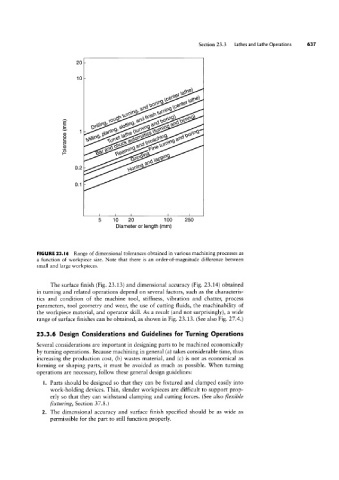
              FIGURE 23.|4  Range of dimensional tolerances obtained in various machining processes as
              a function of workpiece size. Note that there is an order-of-magnitude difference between
              small and large workpieces.


                   The surface finish (Fig. 23.13) and dimensional accuracy (Fig. 23.14) obtained
              in turning and related operations depend on several factors, such as the characteris-
              tics and condition of the machine tool, stiffness, vibration and chatter, process
              parameters, tool geometry and wear, the use of cutting fluids, the machinability of
              the workpiece material, and operator skill. As a result (and not surprisingly), a wide
              range of surface finishes can be obtained, as shown in Fig. 23.13. (See also Fig. 27.4.)

              23.3.6 Design Considerations and Guidelines for Turning Operations

              Several considerations are important in designing parts to be machined economically
              by turning operations. Because machining in general (a) takes considerable time, thus
              increasing the production cost, (b) wastes material, and (c) is not as economical as
              forming or shaping parts, it must be avoided as much as possible. When turning
              operations are necessary, follow these general design guidelines:
                I. Parts should be designed so that they can be fixtured and clamped easily into
                   work-holding devices. Thin, slender workpieces are difficult to support prop-
                   erly so that they can withstand clamping and cutting forces. (See also flexible
                   Hxturing, Section 37.8.)
                2. The dimensional accuracy and surface finish specified should be as wide as
                   permissible for the part to still function properly.

