


Page 404 - Materials Science and Engineering An Introduction
P. 404
376   •  Chapter 10  /  Phase Transformations


                                                                              c


                                                                                               a
                                                                                       a
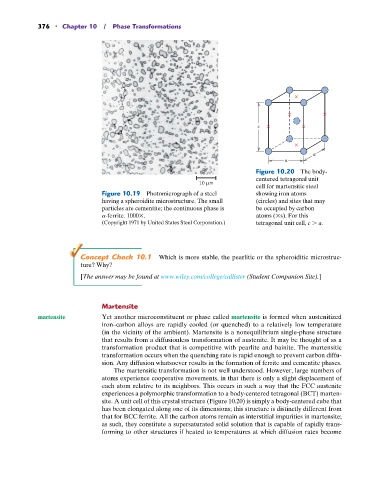
                                                                              Figure 10.20  The body-
                                                                              centered tetragonal unit
                                                             10  m
                                                                              cell for martensitic steel
                                Figure 10.19  Photomicrograph of a steel      showing iron atoms
                                having a spheroidite microstructure. The small   (circles) and sites that may
                                particles are cementite; the continuous phase is   be occupied by carbon
                                a-ferrite. 1000 .                             atoms ( s). For this
                                (Copyright 1971 by United States Steel Corporation.)  tetragonal unit cell, c   a.


                         Concept Check 10.1      Which is more stable, the pearlitic or the spheroiditic microstruc-
                         ture? Why?
                         [The answer may be found at www.wiley.com/college/callister (Student Companion Site).]


                                Martensite
            martensite          Yet another microconstituent or phase called martensite  is formed when austenitized
                                iron–carbon alloys are rapidly cooled (or quenched) to a relatively low temperature
                                (in the vicinity of the ambient). Martensite is a nonequilibrium single-phase structure
                                that results from a diffusionless transformation of austenite. It may be thought of as a
                                transformation product that is competitive with pearlite and bainite. The martensitic
                                transformation occurs when the quenching rate is rapid enough to prevent carbon diffu-
                                sion. Any diffusion whatsoever results in the formation of ferrite and cementite phases.
                                   The martensitic transformation is not well understood. However, large numbers of
                                atoms experience cooperative movements, in that there is only a slight displacement of
                                each atom relative to its neighbors. This occurs in such a way that the FCC austenite
                                experiences a polymorphic transformation to a body-centered tetragonal (BCT) marten-
                                site. A unit cell of this crystal structure (Figure 10.20) is simply a body-centered cube that
                                has been elongated along one of its dimensions; this structure is distinctly different from
                                that for BCC ferrite. All the carbon atoms remain as interstitial impurities in martensite;
                                as such, they constitute a supersaturated solid solution that is capable of rapidly trans-
                                forming to other structures if heated to temperatures at which diffusion rates become

