


Page 403 - Materials Science and Engineering An Introduction
P. 403
10.5 Isothermal Transformation Diagrams  •  375


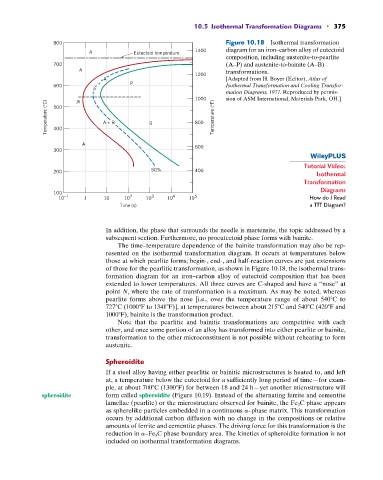
                 800                                                 Figure 10.18  Isothermal transformation
                            A            Eutectoid temperature  1400  diagram for an iron–carbon alloy of eutectoid
                                                                     composition, including austenite-to-pearlite
                 700                                                 (A–P) and austenite-to-bainite (A–B)
                         A                                           transformations.
                                                            1200
                                A                                    [Adapted from H. Boyer (Editor), Atlas of
                              +         P
                 600                                                 Isothermal Transformation and Cooling Transfor-
                             P                                       mation Diagrams, 1977. Reproduced by permis-
                                                            1000     sion of ASM International, Materials Park, OH.]
                        N
               Temperature (°C)  400  A + B   B             800  Temperature (°F)
                 500


                          A                                 600
                 300
                                                                                            Tutorial Video:
                                              50%           400
                 200                                                                            Isothermal
                                                                                            Transformation
                                                                                                 Diagrams
                 100
                   10 –1  1     10    10 2   10 3  10 4   10 5                                How do I Read
                                     Time (s)                                                 a TTT Diagram?


                                 In addition, the phase that surrounds the needle is martensite, the topic addressed by a
                                 subsequent section. Furthermore, no proeutectoid phase forms with bainite.
                                    The time–temperature dependence of the bainite transformation may also be rep-
                                 resented on the isothermal transformation diagram. It occurs at temperatures below
                                 those at which pearlite forms; begin-, end-, and half-reaction curves are just extensions
                                 of those for the pearlitic transformation, as shown in Figure 10.18, the isothermal trans-
                                 formation diagram for an iron–carbon alloy of eutectoid composition that has been
                                  extended to lower temperatures. All three curves are C-shaped and have a “nose” at
                                 point N, where the rate of transformation is a maximum. As may be noted, whereas
                                 pearlite forms above the nose [i.e., over the temperature range of about 540 C to
                                 727 C (1000 F to 1341 F)], at temperatures between about 215 C and 540 C (420 F and
                                 1000 F), bainite is the transformation product.
                                    Note that the pearlitic and bainitic transformations are competitive with each
                                 other, and once some portion of an alloy has transformed into either pearlite or bainite,
                                 transformation to the other microconstituent is not possible without reheating to form
                                 austenite.

                                 Spheroidite
                                 If a steel alloy having either pearlitic or bainitic microstructures is heated to, and left
                                 at, a temperature below the eutectoid for a sufficiently long period of time—for exam-
                                 ple, at about 700 C (1300 F) for between 18 and 24 h—yet another microstructure will
              spheroidite        form called spheroidite (Figure 10.19). Instead of the alternating ferrite and cementite
                                 lamellae (pearlite) or the microstructure observed for bainite, the Fe 3 C phase appears
                                 as spherelike particles embedded in a continuous a–phase matrix. This transformation
                                 occurs by additional carbon diffusion with no change in the compositions or relative
                                 amounts of ferrite and cementite phases. The driving force for this transformation is the
                                 reduction in a–Fe 3 C phase boundary area. The kinetics of spheroidite formation is not
                                 included on isothermal transformation diagrams.

