


Page 398 - Materials Science and Engineering An Introduction
P. 398
370   •  Chapter 10  /  Phase Transformations

                                   During a phase transformation, an alloy proceeds toward an equilibrium state that is
                                characterized by the phase diagram in terms of the product phases and their compositions
                                and relative amounts. As Section 10.3 notes, most phase transformations require some finite
                                time to go to completion, and the speed or rate is often important in the relationship between
                                the heat treatment and the development of microstructure. One limitation of phase diagrams
                                is their inability to indicate the time period required for the attainment of equilibrium.
                                   The rate of approach to equilibrium for solid systems is so slow that true equilibrium
                                structures are rarely achieved. When phase transformations are induced by temperature
                                changes, equilibrium conditions are maintained only if heating or cooling is carried out
                                at extremely slow and unpractical rates. For other-than-equilibrium cooling, transforma-
                                tions are shifted to lower temperatures than indicated by the phase diagram; for heat-
            supercooling        ing, the shift is to higher temperatures. These phenomena are termed   supercooling and
                                superheating,  respectively. The degree of each depends on the rate of temperature
            superheating
                                change; the more rapid the cooling or heating, the greater the supercooling or superheat-
                                ing. For example, for normal cooling rates, the iron–carbon eutectoid reaction is typically
                                displaced 10 C to 20 C (18 F to 36 F) below the equilibrium transformation temperature. 3
                                   For many technologically important alloys, the preferred state or microstructure is
                                a metastable one, intermediate between the initial and equilibrium states; on occasion,
                                a structure far removed from the equilibrium one is desired. It thus becomes imperative
                                to investigate the influence of time on phase transformations. This kinetic information
                                is, in many instances, of greater value than knowledge of the final equilibrium state.


            Microstructural and Property Changes
            in Iron–Carbon Alloys


                                Some of the basic kinetic principles of solid-state transformations are now extended
                                and applied specifically to iron–carbon alloys in terms of the relationships among heat
                                treatment, the development of microstructure, and mechanical properties. This system
                                has been chosen because it is familiar and because a wide variety of microstructures and
                                mechanical properties is possible for iron–carbon (or steel) alloys.


            10.5  ISOTHERMAL TRANSFORMATION DIAGRAMS
                                Pearlite
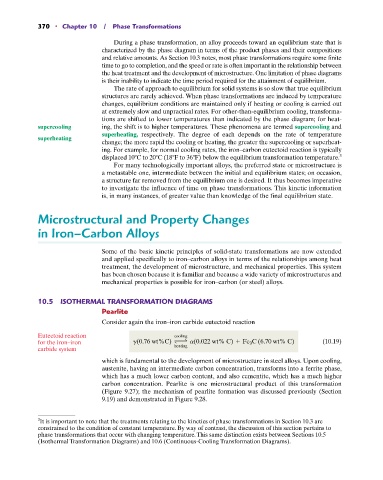
                                Consider again the iron–iron carbide eutectoid reaction
            Eutectoid reaction                       cooling
            for the iron–iron            g(0.76 wt%C) m a(0.022 wt% C) + Fe 3 C (6.70 wt% C)      (10.19)
            carbide system                           heating
                                which is fundamental to the development of microstructure in steel alloys. Upon cooling,
                                austenite, having an intermediate carbon concentration, transforms into a ferrite phase,
                                which has a much lower carbon content, and also cementite, which has a much higher
                                carbon concentration. Pearlite is one microstructural product of this transformation
                                (Figure 9.27); the mechanism of pearlite formation was discussed previously (Section
                                9.19) and demonstrated in Figure 9.28.


            3 It is important to note that the treatments relating to the kinetics of phase transformations in Section 10.3 are
              constrained to the condition of constant temperature. By way of contrast, the discussion of this section pertains to
            phase transformations that occur with changing temperature. This same distinction exists between Sections 10.5
              (Isothermal Transformation Diagrams) and 10.6 (Continuous-Cooling Transformation Diagrams).

