


Page 396 - Materials Science and Engineering An Introduction
P. 396
368   •  Chapter 10  /  Phase Transformations


               100
              Percent recrystallized  60  135 C  119 C  113 C 102 C  88 C  43 C
                80

                40

                20
                 0
                  1              10            10 2                  10 4
                                             Time (min)
                                           (Logarithmic scale)
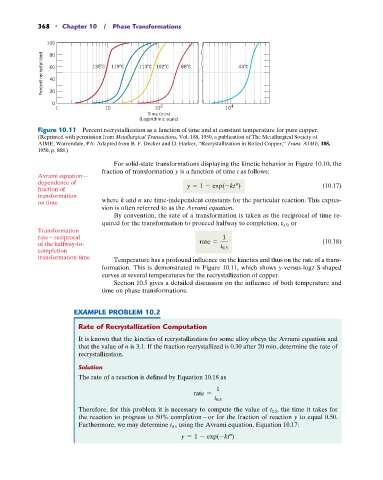
            Figure 10.11  Percent recrystallization as a function of time and at constant temperature for pure copper.
            (Reprinted with permission from Metallurgical Transactions, Vol. 188, 1950, a publication of The Metallurgical Society of
            AIME, Warrendale, PA. Adapted from B. F. Decker and D. Harker, “Recrystallization in Rolled Copper,” Trans. AIME, 188,
            1950, p. 888.)
                                   For solid-state transformations displaying the kinetic behavior in Figure 10.10, the
                                fraction of transformation y is a function of time t as follows:
            Avrami equation—
            dependence of                                               n                         (10.17)
            fraction of                                  y = 1 - exp(-kt )
            transformation
            on time             where k and n are time-independent constants for the particular reaction. This expres-
                                sion is often referred to as the Avrami equation.
                                   By convention, the rate of a transformation is taken as the reciprocal of time re-
                                quired for the transformation to proceed halfway to completion, t 0.5 , or
            Transformation
            rate—reciprocal                                         1
            of the halfway-to-                               rate =                               (10.18)
            completion                                             t 0.5
            transformation time     Temperature has a profound influence on the kinetics and thus on the rate of a trans-
                                formation. This is demonstrated in Figure 10.11, which shows y-versus-log t  S-shaped
                                curves at several temperatures for the recrystallization of copper.
                                   Section 10.5 gives a detailed discussion on the influence of both temperature and
                                time on phase transformations.


                       EXAMPLE PROBLEM 10.2
                         Rate of Recrystallization Computation

                         It is known that the kinetics of recrystallization for some alloy obeys the Avrami equation and
                         that the value of n is 3.1. If the fraction recrystallized is 0.30 after 20 min, determine the rate of
                         recrystallization.
                         Solution
                         The rate of a reaction is defined by Equation 10.18 as
                                                                  1
                                                           rate =
                                                                 t 0.5
                         Therefore, for this problem it is necessary to compute the value of t 0.5 , the time it takes for
                         the reaction to progress to 50% completion—or for the fraction of reaction y  to equal 0.50.
                         Furthermore, we may determine t 0.5  using the Avrami equation, Equation 10.17:
                                                                      n
                                                       y = 1 - exp(-kt )

