


Page 397 - Materials Science and Engineering An Introduction
P. 397
10.4  Metastable Versus Equilibrium States  •  369


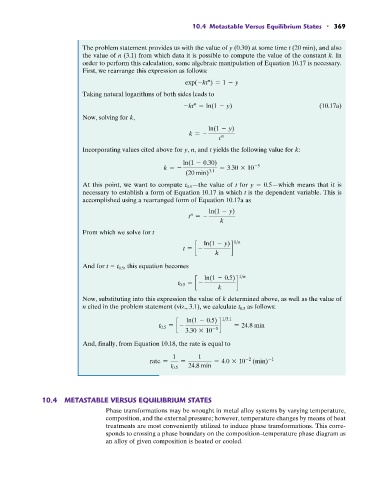
                          The problem statement provides us with the value of y (0.30) at some time t (20 min), and also
                          the value of n (3.1) from which data it is possible to compute the value of the constant k. In
                          order to perform this calculation, some algebraic manipulation of Equation 10.17 is necessary.
                          First, we rearrange this expression as follows:

                                                               n
                                                         exp(-kt ) = 1 - y
                          Taking natural logarithms of both sides leads to
                                                           n
                                                        -kt = ln(1 - y)                          (10.17a)
                          Now, solving for k,

                                                                ln(1 - y)
                                                          k = -
                                                                   t  n
                          Incorporating values cited above for y, n, and t yields the following value for k:

                                                        ln(1 - 0.30)
                                                  k = -         3.1  = 3.30 * 10 -5
                                                         (20 min)
                          At this point, we want to compute t 0.5 —the value of t  for y    0.5—which means that it is
                          necessary to establish a form of Equation 10.17 in which t is the dependent variable. This is
                          accomplished using a rearranged form of Equation 10.17a as
                                                                ln(1 - y)
                                                          n
                                                          t = -
                                                                   k
                          From which we solve for t
                                                              ln(1 - y)  1>n
                                                        t = c -       d
                                                                  k
                          And for t   t 0.5 , this equation becomes

                                                              ln(1 - 0.5)  1>n
                                                      t 0.5 = c -       d
                                                                  k
                          Now, substituting into this expression the value of k determined above, as well as the value of
                          n cited in the problem statement (viz., 3.1), we calculate t 0.5  as follows:

                                                         ln(1 - 0.5)  1>3.1
                                                 t 0.5 = c -     -5 d  = 24.8 min
                                                         3.30 * 10
                          And, finally, from Equation 10.18, the rate is equal to
                                                     1       1             -2     -1
                                              rate =   =         = 4.0 * 10  (min)
                                                    t 0.5  24.8 min


              10.4  METASTABLE VERSUS EQUILIBRIUM STATES
                                 Phase transformations may be wrought in metal alloy systems by varying temperature,
                                 composition, and the external pressure; however, temperature changes by means of heat
                                 treatments are most conveniently utilized to induce phase transformations. This corre-
                                 sponds to crossing a phase boundary on the composition–temperature phase diagram as
                                 an alloy of given composition is heated or cooled.

