


Page 402 - Materials Science and Engineering An Introduction
P. 402
374   •  Chapter 10  /  Phase Transformations

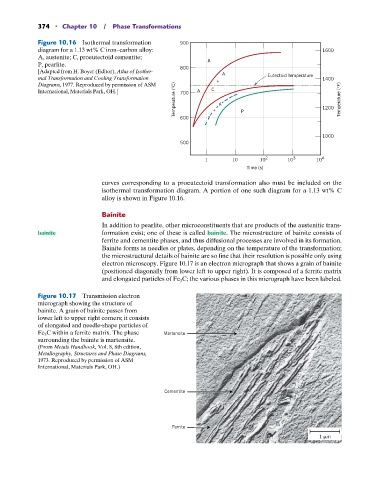
            Figure 10.16  Isothermal transformation    900
            diagram for a 1.13 wt% C iron–carbon alloy:                                           1600
            A, austenite; C, proeutectoid cementite;
            P, pearlite.                                       A
                                                       800
            [Adapted from H. Boyer (Editor), Atlas of Isother-
                                                                    A            Eutectoid temperature
            mal Transformation and Cooling Transformation         +                               1400
            Diagrams, 1977. Reproduced by permission of ASM
                                                      Temperature (°C)  A                         1200 Temperature (°F)
            International, Materials Park, OH.]        700  A    C


                                                       600     P  +      P

                                                                                                  1000
                                                       500


                                                               1       10      10 2    10 3     10 4
                                                                           Time (s)

                                curves corresponding to a proeutectoid transformation also must be included on the
                                isothermal transformation diagram. A portion of one such diagram for a 1.13 wt% C
                                alloy is shown in Figure 10.16.


                                Bainite
                                In addition to pearlite, other microconstituents that are products of the austenitic trans-
            bainite             formation exist; one of these is called bainite. The microstructure of bainite consists of
                                ferrite and cementite phases, and thus diffusional processes are involved in its formation.
                                Bainite forms as needles or plates, depending on the temperature of the transformation;
                                the microstructural details of bainite are so fine that their resolution is possible only using
                                electron microscopy. Figure 10.17 is an electron micrograph that shows a grain of bainite
                                (positioned diagonally from lower left to upper right). It is composed of a ferrite matrix
                                and elongated particles of Fe 3 C; the various phases in this micrograph have been labeled.

            Figure 10.17  Transmission electron
              micrograph showing the structure of
            bainite. A grain of bainite passes from
            lower left to upper right corners; it consists
            of elongated and needle-shape particles of
            Fe 3 C within a ferrite matrix. The phase   Martensite
            surrounding the bainite is martensite.
            (From Metals Handbook, Vol. 8, 8th edition,
            Metallography, Structures and Phase Diagrams,
            1973. Reproduced by permission of ASM
            International, Materials Park, OH.)


                                                  Cementite


                                                     Ferrite

