


Page 112 - Mechanical Engineers Reference Book
P. 112
Analogue and digital electronics theory  2/53


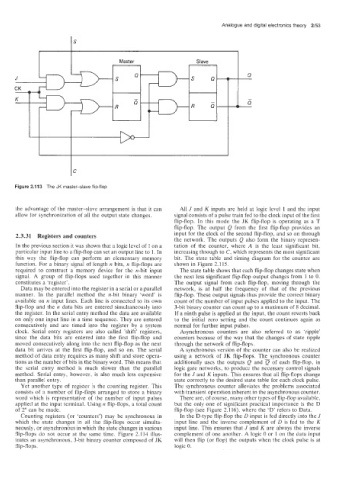
      Figure 2.113  ‘The JK master-slave  flip-flop


      the advantage  of  the  master-slave  arrangement is that it can   All J  and K  inputs  are held  at logic level  1 and the  input
      allow for synchronization  of  all the output state changes.   signal consists of a pulse train fed to the clock input of  the first
                                                    flip-flop.  In  this  mode  the  JK  flip-flop  is  operating  as  a  T
                                                    flip-flop.  The  output  Q  from  the  first  flip-flop  provides  an
      2.3.31  Registers and counters                input for the clock of  the second flip-flop, and so on through
                                                    the  network.  The outputs Q also form  the  binary  represen-
      In the previous section it was shown that a logic level of  1 on a   tation  of  the  counter,  where  A  is  the  least  significant  bit,
      particular input line to a flip-flop can set an output line to 1. In   increasing through to C, which represents the most significant
      this  way  the  flip-flop  can  perform  an  elementary  memory   bit.  The state table  and  timing  diagram  for  the  counter  are
      function.  For a binary  signal of  length n bits, n flip-flops are   shown in Figure 2.115.
      required  to  construct  a  memory  device  for  the  n-bit  input   The state table shows that each flip-flop changes state when
      signal.  A  group  of  flip-flops  used  together  in  this  manner   the next less significant flip-flop output changes from 1 to 0.
      constitutes a ‘register’.                     The output  signal  from  each  flip-flop,  moving  through  the
       Data may be entered into the register in a serial or a parallel   network,  is  at  half  the  frequency  of  that  of  the  previous
      manner.  In  the  parallel  method  the  n-bit  binary  ‘word’ is   flip-flop. These output signals thus provide the correct binary
      availabde on n input  lines. Each line is connected  to its own   count of the number of  input pulses applied to the input. The
      flip-flop and the n  data bits  are entered simultaneously  into   3-bit binary counter can count up to a maximum of  8 decimal.
      the register.  In the serial entry method the data are available   If a ninth pulse is applied at the input, the count reverts back
      on only one input line in a time sequence.  They are entered   to the  initial  zero setting  and  the  count  continues  again  as
      consecutively  and  are  timed  into  the  register  by  a  system   normal for further input pulses.
      clock.  Serial  entry  registers  are  also  called  ’shift’ registers,   Asynchronous  counters  are  also  referred  to  as  ’ripple’
      since  the  data  bits  are  entered  into  the  first  flip-flop  and   counters because of  the way that the  changes  of  state ripple
      moved  consecutively along into the next flip-flop as the next   through  the network of flip-flops.
      data  bit  arrives  at the  first  flip-flop,  and  so  on.  The  serial   A synchronous version  of  the counter can also be realized
      method of  data entry requires  as many shift and store opera-   using  a  network  of  JK  flip-flops.  Thesynchronous  counter
      tions as the number of bits in the binary word. This means that   additionally  uses  the  outputs  Q  and  Q  of  each  flip-flop,  in
      the  serial  entry  method  is  much  slower  than  the  parallel   logic gate networks,  to produce the necessary control signals
      method.  Serial  entry,  however,  is  also  much  less  expensive   for the J  and K inputs. This ensures that a11 flip-flops change
      than parallel. entry.                         state correctly to the desired state table for each clock pulse.
       Yet  another type  of  register  Is  the  counting register.  This   The synchronous counter alleviates  the  problems  associated
      consists of  a number of  flip-flops arranged  to store a binary   with transient operation inherent in the asynchronous counter.
      word  which  is  representative  of  i.he  number of  input  pulses   There are, of course, many other types of flip-flop available,
      applied at the input terminal. Using n flip-flops, a total count   but  the  only one of  significant practical  importance  is the D
      of  2” can be made.                           flip-flop (see Figure 2.116), where the ‘D’ refers to Data.
       Counting  registers  (or  ‘counters’)  may  be  synchronous  in   In the D-type flip-flop the D input is fed directly into the J
      which  the  state  changes  in  all  the  flip-flops  occur  simulta-   input  line and the inverse complement  of  D  is fed  to the  K
      neousby, or asynchronous in which the state changes in various   input  line.  This ensures that J  and K  are  always the  inverse
      flip-flops  do not  occur  at the  same time.  Figure  2.114 illus-   complement  of  one another. A logic 0 or 1 on the data input
      trates an asynchronous, 3-bit binary counter composed of JK   will then  flip (or flop) the outputs when the clock pulse is at
      flip-flops.                                   logic 0.

