


Page 144 - Mechanical Engineers Reference Book
P. 144
Instrumentation  3/27
       A. C. power                                   A. C. power


                                                          I
         I  I’                              1           I II      Figure 3.49  Principle of synchrc

      relative to them. This system has the particular advantage that   proportional  to rate of  change of flux, generators, either d.c.
      if  a  second, identical unit  is connected  appropriately  (right-   or ax., can be made for which output voltage gives a direct
      hand side of Figure 3.49) forces will act within it until the two   measure  of  the speed of  rotation. Under a completely  diffe-
      rotors take  up identical  angles.  This is  a  robust  and widely   rent  principle,  a  technique  is  to  mount  markers  on  the
      used technique  for telemetering  an angular position.   circumference  of  a  rotor  and  count  the  number  passing  a
        Capacitive transducers  with variable overlap readily give a   stationary  point  in  a  given  time,  or  alternatively,  the  time
      measurement  of  angle. The arrangement is in fact just that of   lapse  between  successive  passages,  which  can  be  detected
      the orthodox variable capacitor.               optically,  magnetically  or  electrostatically.  This  system,  of
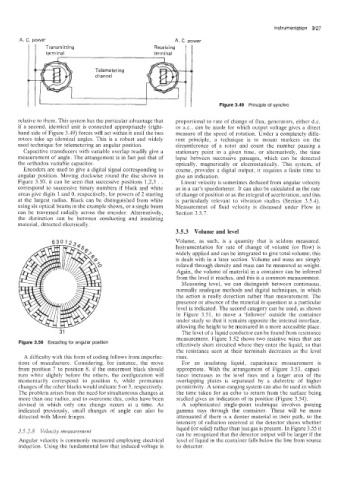
        Encoders  are used to give a digital signal corresponding to   course,  provides  a digital  output; it  requires  a  finite time to
      angular position.  Moving clockwise round  the disc shown in   give an indication.
      Figure  3.50, it can be seen that successive positions  1,2,3 . .   Linear velocity is sometimes deduced from angular velocity
      correspond  to successive binary  numbers  if  black  and  white   as in a car’s speedometer. It can also be calculated as the rate
      areas give digits 1 and 0, respectively,  for powers of 2 starting   of change of position or as the integral of acceleration, and this
      at the largest  radius.  Black  can be distinguished  from white   is  particularly  relevant  to  vibration  studies  (Section  3.5.4).
      using six optical beams in the example shown, or a single beam   Measurement  of  fluid  velocity  is  discussed  under  Flow  in
      can  be  traversed  radially  across  the  encoder. Alternatively,   Section 3.5.7.
      the  distinction  can  be  between  conducting  and  insulating
      material, detected  electrically.
                                                     3.5.3  Volume and level
                                                     Volume,  as  such,  is  a  quantity  that  is  seldom  measured.
                                                     Instrumentation  for  rate  of  change  of  volume  (or  flow)  is
                                                     widely applied and can be integrated to give total volume; this
                                                     is dealt with in a later section. Volume  and mass are simply
                                                     related through density and mass can be measured as weight.
                                                     Again, the volume of  material in a container can be inferred
                                                     from the level it reaches, and this is a common measurement.
                                                       Measuring  level,  we  can  distinguish  between  continuous,
                                                     normally  analogue methods and digital techniques.  in which
                                                     the  action  is really  detection  rather  than  measurement. The
                                                     presence or absence of the material in question at a particular
                                                     level is indicated. The second category can be used, as shown
                                                     in  Figure  3.51.  to  move  a  ‘follower’ outside  the  container
                                                     under study so that it remains opposite the internal interface,
                                                     allowing the height to be measured in a more accessible place.
                  31                                   The level of a liquid conductor can be found from resistance
                                                     measurement.  Figure 3.52 shows two resistive wires that are
      Figure 3.50  Encoding for angular position     effectively short circuited where they enter the liquid, so that
                                                     the  resistance  seen  at  their  terminals  decreases  as  the  level
        A difficulty with this form of  coding follows from imperfec-   rises.
      tions  of  manufacture.  Considering,  for  instance,  the  move   For  an  insulating  liquid,  capacitance  measurement  is
      from  position  7 to position  8. if  the  outermost  black  should   appropriate.  With  the  arrangement  of  Figure  3.53, capaci-
      turn  white  slightly before  the  others,  the  configuration  will   tance  increases  as  the  level  rises  and  a  larger  area  of  the
      momentarily  correspond  to  position  6,  while  premature   overlapping  plates  is  separated  by  a  dielectric  of  higher
      changes of the other blacks would indicate 5 or 3, respectively.   permittivity. A sonar-ranging system can also be used in which
      The problem arises from the need for simultaneous changes at   the time  taken for an echo to return from the surface being
      more than one radius. and to overcome this, codes have been   studied gives an indication of  its position  (Figure 3.54).
      devised  in  which  only  one  change  occurs  at  a  time.  As   A  sophisticated  single-point  technique  involves  passing
      indicared  previously,  small  changes  of  angle  can  also  be   gamma  rays  through  the  container.  These  will  be  more
      detected  with Moire fringes.                  attenuated if  there is a denser  material  in their  path, so the
                                                     intensity of  radiation  received  at the detector shows whether
      3.5.2.8  Velocity measurement                  liquid (or solid) rather than just gas is present. In Figure 3.55 it
                                                     can be recognized that the detector output will be larger if  the
      Angular  velocity is commonly measured employing electrical   level of  liquid in the container falls below the line from source
      induction.  Using the fundamental  law that induced voltage is   to detector.

