


Page 141 - Mechanical Engineers Reference Book
P. 141
3/24  Microprocessors, instrumentation and control
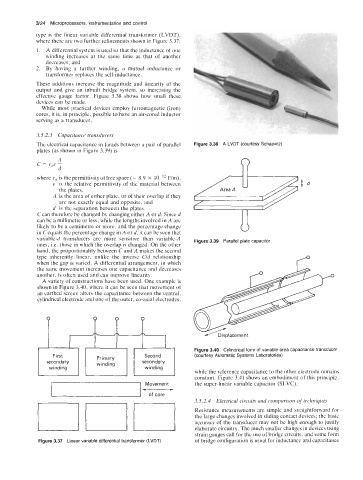
            type  is the  linear  variable  differential  transformer  (LVDT),
            where there are two further refinements shown in Figure 3.37:
            1.  A differential system is used so that the inductance of one
              winding  increases  at  the  same  time  as  that  of  another
               decreases; and
            2.  By  having  a  further  winding,  a  mutual  inductance  or
              transformer  replaces the self-inductance.
            These  additions  increase  the  magnitude  and linearity  of  the
            output  and  give an  inbuilt  bridge  system,  so increasing  the
            effective  gauge  factor.  Figure  3.38 shows  how  small  these
            devices can be  made.
             While  most  practical  devices  employ ferromagnetic  (iron)
            cores, it is, in principle, possible to have an air-cored inductor
            serving as a transducer.
            3.5.2.3  Capacitance transducers
            The electrical capacitance in farads between a pair of  parallel   Figure 3.38  A LVDT (courtesy Schaevitz)
            plates (as shown in Figure 3.39) is
                  A
            c = EO& -                                                   R
                  d
            where  E,  is the permittivity of free space (= 8.9 X  lo-'*  F/m),
                 E  is the relative  permittivity  of  the material  between
                  the plates,
                 A  is the area of  either plate, or of  their overlap if they
                  are not exactly equal and opposite,  and
                 d  is the separation between the plates.
            C can therefore be changed by changing either A or d. Since d
            can be a millimetre or less, while the lengths involved in A are   0
            likely to be a centimetre or more, and the percentage change
            in C equals the percentage change in A or d, it can be seen that
            variable-d  transducers  are  more  sensitive  than  variable-A   Figure 3.39  Parallel plate capacitor
            ones, i.e. those in which the overlap is changed. On the other
            hand, the proportionality between C and A makes the second
            type  inherently  linear,  unlike  the  inverse  C/d  relationship
            when the gap is varied.  A differential arrangement, in which
            the same movement increases one capacitance  and decreases
            another,  is often used and can improve linearity.
             A variety of  constructions have been used. One example is
            shown in Figure 3.40, where it can be seen that movement of
            an earthed screen alters the capacitance between the central,
            cylindrical electrode and one of  the outer, co-axial electrodes,


                             .     P.     /.


                                                           Figure 3.40  Cylindrical form of  variable-area capacitance transducer
                First         Primary       Second         (courtesy Automatic Systems Laboratories)
               secondary      winding      secondary
               winding
                                            winding
            -uu
                                                           while the reference capacitance to the other electrode remains
                                                           constant. Figure 3.41 shows an embodiment of this principle,
                                            Movement       the super-linear variable capacitor (SLVC).
                                             of core
                                                          3.5.2.4  Electrical circuits and comparison of techniques
                                                           Resistance measurements  are simple and straightforward for
                                                           the large changes involved in sliding contact devices; the basic
                                                           accuracy of  the transducer  may not be high enough to justify
                                                           elaborate circuitry. The much smaller changes in devices using
                                                           strain gauges call for the use of bridge circuits, and some form
            Figure 3.37  Linear variable differential transformer (LVDT)   of bridge configuration is usual for inductance and capacitance

