


Page 140 - Mechanical Engineers Reference Book
P. 140
Instrumentation  3/23
     hazards  include electrical interference and nuclear  radiation.
     The capabilities of  particular items to withstand all these are
     often not spelt out. Common sense is often called for to judge
     what  is  reasonable  to expect.  Sometimes  precise  limits  are
     quoted by suppliers, but it should be noted that approaching
     these limits closely may reduce accuracy and especially relia-
     bility.

     3.5.1.4  Frequency coverage
     A simple description  of  what  an instrument does may imply
     that there is an indefinite amount of  time in which to make a
     measurement  - the steady-state or d.c. behaviour. Sometimes
     this is not the whole relevant story. There are certain devices
     that  cannot  be used  for steady-state measurements  but  only
     for  varying  ones.  There  is  always  an  upper  limit  to  the
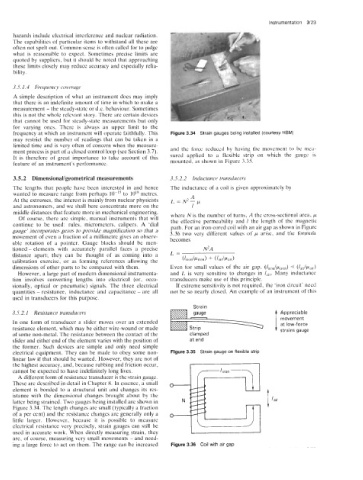
     frequency at which an instrument will operate faithfully. This   Figure 3.34  Strain gauges being installed (courtesy HBM)
     may  restrict  the number of  readings  that can  be taken  in  a
     limited  time and is very often of  concern when the measure-
     ment process is part of a closed control loop (see Section 3.7).   and the force  reduced  by  having  the  movement  to be  mea-
     It  is  therefore of  great  importance  to  take  account  of  this   sured  applied  to  a  flexible  strip  on which  the  gauge  is
     feature of  an instrument’s  performance.     mounted, as shown in Figure 3.35.
     3.5.2  DimensionaVgeometrical measurements    3.5.2.2  Inductance transducers
     The lengths that  people  have  been  interested  in  and hence   The inductance of  a coil is given approximately by
     wanted to measure range from perhaps  lo-’’  to 10”  metres.
     At the extremes, the interest is mainly from nuclear physicists   L  = N  A  ~  -  ~
     and astronomers, and we shall here concentrate more on the   1
     middle distances that feature more in mechanical engineering.
       Of  course,  there are simple, manual  instruments  that will   where N  is the number of  turns, A the cross-sectional area, p
     continue  to  be  used:  rules,  micrometers,  calipers.  A  ‘dial   the  effective  permeability  and  I  the  length  of  the  magnetic
     gauge’ incorporates  gears to provide  magnification so that a   path. For an iron-cored coil with an air gap as shown in Figure
     movement of  even a fraction of  a millimetre gives an observ-   3.36  two  very  different  values  of  p  arise,  and  the  formula
     able  rotation  of  a  pointer.  Gauge  blocks  should  be  men-   becomes
     tioned - elements  with  accurately  parallel  faces  a  precise   N~A
     distance  apart;  they  can  be  thought  of  as  coming  into  a   L=
     calibration  exercise,  or  as  forming  references  allowing  the   (lironlpiron)  + (4dpair)
     dimensions of  other parts to be compared  with them.   Even  for  small  values  of  the  air gap,  (Ziron/p+ron) (lalJpalr)
                                                                                       Q
       However, a large part of  modern dimensional instrumenta-   and  L  is very  sensitive to changes  in  lair. Many  inductance
     tion  involves  converting  lengths  into  electrical  (or,  occa-   transducers  make use of  this principle.
     sionally,  optical  or  pneumatic)  signals.  The three electrical   If extreme sensitivity is not required, the ‘iron circuit’ need
     quantities - resistance,  inductance  and  capacitance - are  all   not be so nearly closed.  An example of  an instrument of this
     used in transducers for this purpose.
                                                          Strain
     3.5.2.1  Resistance transducers                                                Appreciable
                                                                                    movement
     In  one form of  transducer  a slider moves over  an extended                  at low-force
     resistance element, which may be either wire-wound or made                     strains gauge
     of some non-metal. The resistance between the contact of  the   clamped
     slider and either end of the element varies with the position of   at end
     the  former.  Such  devices  are  simple  and  only  need  simple
     electrical  equipment. They  can be made to obey some non-   Figure 3.35  Strain gauge on flexible strip
     linear law if that should be wanted.  However, they are not of
     the highest accuracy, and, because rubbing and friction occur,
     cannot be expected to have indefinitely long lives.          /iron
       A different form of resistance transducer is the strain gauge.
     These are described in detail in Chapter 8. In essence, a small
     element  is  bonded  to  a  structural  unit  and  changes  its  res-
     istance  with  the  dimensional  changes  brought  about by  the
     latter being strained. Two gauges being installed are shown in
     Figure 3.34. The length changes are small (typically a fraction
     of  a per cent) and the resistance changes are generally only a
     little  larger.  However,  because  it  is  possible  to  measure
     electrical  resistance  very precisely,  strain gauges can  still be
     used in accurate work.  When  directly measuring strain, they
     are, of  course, measuring very small movements - and need-
     ing a large force to act on them. The range can be increased   Figure 3.36  Coil with air gap

