


Page 137 - Mechanical Engineers Reference Book
P. 137
-

       3/20  Microprocessors, instrumentation and control


                                                                     il+
                                                                            } vi


                                                      I

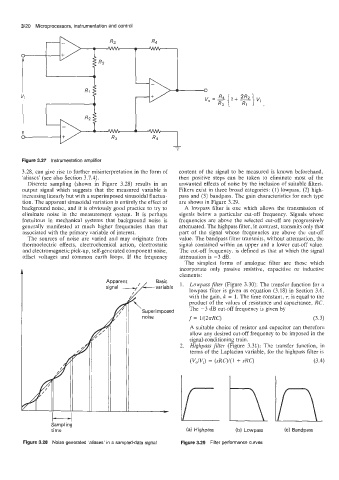
        Figure 3.27  Instrumentation amplifier
        3.28. can give rise to further misinterpretation  in the form of   content of  the  signal to be  measured  is  known  beforehand,
        'aliases'  (see also Section 3.7.4).          then  positive  steps  can  be  taken  to  eliminate  most  of  the
         Discrete  sampling  (shown  in  Figure  3.28)  results  in  an   unwanted  effects of  noise by the inclusion of  suitable filters.
        output  signal  which  suggests  that  the  measured  variable  is   Filters exist in three broad  categories: (1) lowpass,  (2) high-
        increasing linearly but with a superimposed sinusoidal fluctua-   pass and (3) bandpass. The gain characteristics for each type
        tion. The apparent sinusoidal variation is entirely the effect of   are shown in Figure 3.29.
        background  noise,  and it is obviously good practice to try to   A  lowpass  filter  is  one which  allows  the  transmission  of
        eliminate  noise  in  the  measurement  system.  It  is  perhaps   signals  below  a  particular  cut-off  frequency.  Signals whose
        fortuitous  in  mechanical  systems  that  background  noise  is   frequencies  are  above  the  selected  cut-off  are progressively
        generally  manifested  at  much  higher  frequencies  than  that   attenuated. The highpass filter, in contrast, transmits only that
        associated with the primary variable of  interest.   part  of  the  signal  whose  frequencies  are  above  the  cut-off
         The  sources  of  noise  are  varied  and  may  originate  from   value. The bandpass filter transmits, without attenuation, the
        thermoelectric  effects,  electrochemical  action,  electrostatic   signal contained  within  an upper  and  a lower  cut-off value.
        and electromagnetic pick-up, self-generated component noise,   The cut-off frequency.  is defined as that  at which the signal
        offset  voltages  and  common  earth  loops.  If  the  frequency   attenuation is  -3  dB.
                                                        The  simplest  forms  of  analogue  filter  are  those  which
                                                      incorporate  only  passive  resistive,  capacitive  or  inductive
                                                      elements:
                                               Basic
                                                       1.  Lowpass filter  (Figure 3.30): The transfer  function  for a
                                                         lowpass filter is given as equation  (3.18) in  Section  3.6,
                                                         with the gain, k  = 1. The time constant,  r, is equal to the
                                   p       Superimposed   product  of  the values of  resistance  and capacitance, RC.
                                                         The -3  dB cut-off frequency is given by
                                           noise
                                                         f = 142.lrRC)
                                                                                              (3.3)
                                                         A suitable choice of  resistor  and capacitor can therefore
                                                         allow any desired cut-off frequency to be imposed in the
                                                         signal-conditioning train.
                                                         Highpass filter  (Figure  3.31):  The  transfer  function,  in
                                                         terms of  the Laplacian variable, for the highpass filter is
                                                         (VJVJ = (sRC)/(l + sRC)              (3.4)

                                                                     I


                                   -
                 I----
                Sampling
                time                                    (a) Highpass   (b) Lowpass    (c) Bandpass
        Figure 3.28  Noise generated 'aliases' in a sampled-data signal   Figure 3.29  Filter performance curves

