


Page 138 - Mechanical Engineers Reference Book
P. 138
Instrumentation  3/21

               R                                   3.5  Instrumentation
                                                   3.5.1  Introduction
                                                   Many aspects of mechanical engineering depend essentially on
                                                   the  ability to make measurements  of  relevant  quantities.  In
                                                   some areas,  such as non-destructive  testing  or experimental
                                                   stress analysis,  the  techniques for making  the measurements
                                                    are linked  so closely to the rest  of  the subject that they  are
                                                   better dealt with in their particular context. Here, we consider
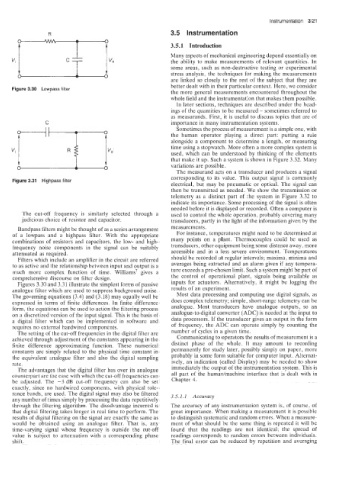
     Figure 3.30  Lowpass filter
                                                    the more general measurements  encountered  throughout the
                                                   whole field and the instrumentation that makes them possible.
                                                     In later sections, techniques are described under the head-
                                                    ings of  the quantities to be measured - sometimes referred  to
                                                    as measurands.  First, it is useful to discuss topics that  are of
               C                                   importance in many instrumentation  systems.
                                                     Sometimes the process of measurement is a simple one, with
                                                    the  human  operator  playing  a  direct  part:  putting  a  rule
                                                    alongside  a component  to determine  a length,  or measuring
                                                    time using a stopwatch. More often a more complex system is
                                                    used,  which can be  understood  by  thinking of  the  elements
                       -                           that make it up. Such a system is shown in Figure 3.32. Many
                                                   variations are possible.
      0                A        0
                                                     The measurand  acts on a transducer  and produces a signal
     Figure 3.31  Highpass filter                   corresponding  to  its  value.  This  output  signal is  commonly
                                                    electrical,  but  may  be pneumatic  or  optical.  The signal can
                                                    then be transmitted  as needed. We show the transmission  or
                                                    telemetry  as  a  distinct  part  of  the  system  in  Figure  3.32 to
                                                    indicate its importance.  Some processing of  the signai is often
                                                    needed before it is displayed or recorded. Often a computer is
        The  cut-off  frequency  is  similarly  selected  through  a   used to control the whole operation. probably covering many
        judicious choice of  resistor  and capacitor.   transducers, partly in the light of the information given by the
      Bandpass filters might be thought of as a series arrangement   measurements.
     of  a  lowpass  and  a  highpass  filter.  With  the  appropriate   For instance. temperatures might need to be determined at
     combinations  of  resistors  and capacitors,  the  low- and high-   many  points  on  a  plant.  Thermocouples  could  be  used  as
     frequency  noise  components  in  the  signal  can  be  suitably   transducers, other equipment being some distance away, more
     attenuated as required.                        accessible  and  in  a  less  severe  environment.  Temper- dura
      Filters which include an amplifier in the circuit are referred   should be recorded at regular intervals; maxima, minima and
     bo  as active and the relationship between input and output is a   averages being extracted  and an alarm given if  any tempera-
     much  more  complex  function  of  time.  Williams7  gives  a   ture exceeds a pre-chosen limit. Such a system might be part of
     comprehensive discourse on filter design.      the  control  of  operational plant,  signals  being  available  as
      Figures 3.30 and 3.31 illustrate the simplest forms of passive   inputs  for  actuators. Alternatively,  it  might  be  logging  the
     analogue filter which are used to suppress background  noise.   results of  an experiment.
     The governing equations (3.4) and (3.18) may equally well be   Most data processing and computing use digital signals. as
     expressed  in  terms  of  finite  differences.  In  finite  difference   does complex telemetry; simple, short-range telemetry can he
     form, the equations can be used to action the fiitering process   analogue.  Most  transducers  have  analogue  outputs,  so  an
     on a discretized version of the input signal. This is the basis of   analogue-to-digital converter (ADC) is needed at the input to
     a  digital  filter  which  can  be  implemented  in  software  and   data processors. If  the transducer gives an output in the form
     requires no external  hardwired components.    of  frequency,  the ADC can  operate simply by  counting the
      The setting of the cut-off frequencies in the digital filter are   number of  cycles in a given time.
     achieved through adjustment of the constants appearing in the   Communicating to operators the results of measurement is a
     finite  difference  approximating  function.  These  numerical   distinct  phase  of  the  whole.  It  may  amount  to  recording
     constants  are simply related  to the physical time constant  in   permanently  for study  later, possibly simply on paper, more
     the  equivalent  analogue  filter  and  also  the  digital  sampling   probably in some form suitable for computer input. Alternat-
     rate.                                          ively, an indication (called Display)  may be needed  to show
      The advantages that the digital filter has over its analogue   immediately the output of the instrumentation  system. This is
     counterpart are the ease with which the cut-off frequencies can   all part  of  the humanhachine interface  that is  dealt with in
     be  adjusted.  The  -3  dB  cut-off  frequency  can  also  be  set   Chapter 4.
     exactly,  since  no hardwired  components,  with  physical tole-
     rance bands, are used. The digital signal may also be filtered   3.5.1.1  Accuracy
     any number of times simply by processing the data repetitively
     through  the filtering algorithm. The disadvantage incurred is   The accuracy of  any instrumentation  system is, of  course, of
     that digitai filtering takes longer in real time to perform. The   great importance.  When making a measurement  it is possible
     results of digital filtering on the signal are exactly the same as   to distinguish systematic and random errors. When a measure-
     would  be  obtained  using  an  analogue  filter.  That  is,  any   ment  of  what should be the same thing is repeated  it will be
     time-varying  signal  whose  frequency  is  outside  the  cut-off   found  that  the  readings  are  not  identical;  the  spread  of
     value  is  subject  to  atteeuation  with  a  corresponding  phase   readings corresponds  to random errors between  individuals.
     shift.                                         The final  error  can  be  reduced  by  repetition  and  averaging

