


Page 143 - Mechanical Engineers Reference Book
P. 143
3/26  Microprocessors, instrumentation and control


                                                              Pressure
                                                              gauge
                                                       Air supply


                                                              Restrictor             Flapper
                                                                             Nozzle
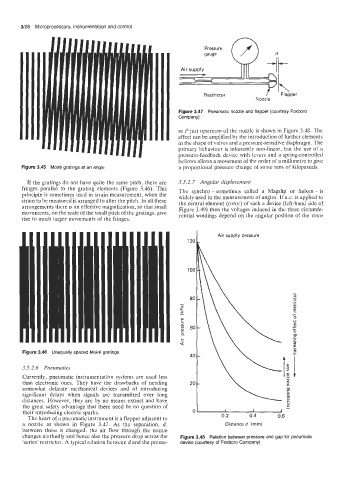
                                                      Figure 3.47  Pneumatic nozzle and flapper (courtesy Foxboro
                                                      Company)

                                                      re P just upstream of  the nozzle is shown in Figure 3.48. The
                                                      effect can be amplified by the introduction of further elements
                                                      in the shape of valves and a pressure-sensitive  diaphragm. The
                                                      primary  behaviour  is inherently  non-linear,  but  the use  of  a
                                                      pressure-feedback  device with levers and a spring-controlled
                                                      bellows allows a movement of the order of a millimetre to give
       Figure 3.45  Moire gratings at an angle        a proportional  pressure change of  some tens of kilopascals.

         If  the gratings do not have quite the same pitch,  there are   3.5.2.7  Angular displacement
       fringes  parallel  to  the  grating  elements  (Figure  3.46).  This   The  synchro - sometimes  called  a  Magslip  or  Selsyn - is
       principle is sometimes used  in strain measurement, when the   widely used in the measurement  of angles. If ax. is applied to
       strain to be measured is arranged to alter the pitch. In all these   the central element  [rotor)  of such a device (left-hand side of
        arrangements there is an effective magnification, so that small   Figure 3.49) then the voltages induced in the three circumfe-
        movements, on the scale of the small pitch of the gratings, give   rential windings depend on the angular position  of  the  rotor
        rise to much larger movements of the fringes.

                                                                  Air supply pressure
                                                         120


                                                         100


                                                         80
                                                      I
                                                       m
                                                      a
                                                      YI
                                                       E
                                                         60
                                                       E
                                                       n
                                                       ._
                                                       L
                                                       Q
        Figure 3.46  Unequally spaced Moire gratings
                                                         40
        3.5.2.6  Pneumatics
        Currently, pneumatic  instrumentation  systems  are used  less
        than  electronic  ones.  They  have  the  drawbacks  of  needing   20
        somewhat  delicate  mechanical  devices  and  of  introducing
        significant  delays  when  signals  are  transmitted  over  long
        distances.  However, they  are by no  means  extinct and have
                                                                                      c
        the great safety advantage that there need be no question of                  -
                                                                                      0
        their introducing electric sparks.                0         I       I        I
         The heart of  a pneumatic instrument is a flapper adjacent to   0.2   0.4   0.6
        a  nozzle  as  shown  in  Figure  3.47.  As  the  separation,  d,   Distanced  (mm)
        between  these  is  changed,  the  air  flow  through  the  nozzle
        changes markedly and hence also the pressure drop across the   Figure 3.48  Relation between pressure and gap for pneumatic
        ‘series’ restrictor.  A typical relation between d and the pressu-   device (courtesy of  Foxboro Company)

