


Page 211 - Mechanical Engineers' Handbook (Volume 4)
P. 211
200   Heat-Transfer Fundamentals

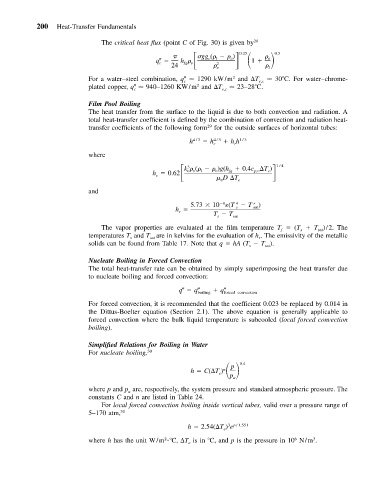
                             The critical heat flux (point C of Fig. 30) is given by 28
                                                   h     gg (      )   0.25  1       0.5

                                            q       fg v   c  l  v          v
                                             c
                                                 24           2 v            l
                                                                  2
                          For a water–steel combination, q     1290 kW/m and  T    30 C. For water–chrome-
                                                    c                    e,c
                          plated copper, q     940–1260 KW/m and  T    23–28 C.
                                                        2
                                      c                        e,c
                          Film Pool Boiling
                          The heat transfer from the surface to the liquid is due to both convection and radiation. A
                          total heat-transfer coefficient is defined by the combination of convection and radiation heat-
                          transfer coefficients of the following form for the outside surfaces of horizontal tubes:
                                                           29
                                                      h 4/3    h 4 /3    hh 1/3
                                                            c
                                                                  r
                          where
                                           h   0.62  k   (      )g(h   0.4c  T )   1/4
                                                     3
                                                             v
                                                     vv
                                                                        p,v
                                                                           e
                                                         l
                                                                 fg
                                            c
                                                               D  T e
                                                              v
                          and
                                                                       r
                                                                   4
                                                      5.73   10  (T   T )
                                                               8
                                                  h                s   sat
                                                   r
                                                            T   T sat
                                                             s
                             The vapor properties are evaluated at the film temperature T   (T   T )/2. The
                                                                               f
                                                                                    s
                                                                                         sat
                          temperatures T and T are in kelvins for the evaluation of h . The emissivity of the metallic
                                           sat
                                                                         r
                                     s
                          solids can be found from Table 17. Note that q   hA (T   T ).
                                                                      s
                                                                           sat
                          Nucleate Boiling in Forced Convection
                          The total heat-transfer rate can be obtained by simply superimposing the heat transfer due
                          to nucleate boiling and forced convection:
                                                   q    q  boiling    q  forced convection
                          For forced convection, it is recommended that the coefficient 0.023 be replaced by 0.014 in
                          the Dittus-Boelter equation (Section 2.1). The above equation is generally applicable to
                          forced convection where the bulk liquid temperature is subcooled (local forced convection
                          boiling).
                          Simplified Relations for Boiling in Water
                          For nucleate boiling, 30
                                                      h   C( T )    0.4
                                                                 p
                                                               n
                                                              e
                                                                 p a
                          where p and p are, respectively, the system pressure and standard atmospheric pressure. The
                                     a
                          constants C and n are listed in Table 24.
                             For local forced convection boiling inside vertical tubes, valid over a pressure range of
                          5–170 atm, 31
                                                                3 p /1.551
                                                     h   2.54( T ) e
                                                               e
                                                                                        3
                                                                                   6
                          where h has the unit W/m   C,  T is in  C, and p is the pressure in 10 N/m .
                                               2
                                                     e

