


Page 199 - Mechanism and Theory in Organic Chemistry
P. 199
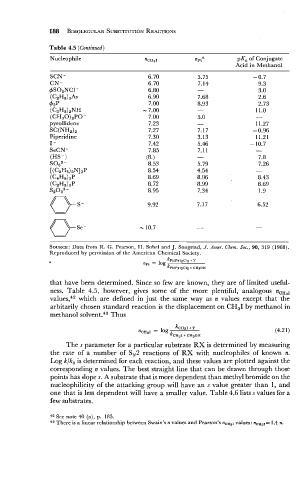
Table 4.5 (Continued)
                Nucleophile                 ~CH,I           npta        pK,  of Conjugate
                                                                        Acid in Methanol
                SCN  -
                CN-
                4S02NCl -
                (C2H5)3As
                43p
                (C2H5)2NH
                (CH30),P0 -
                pyrollidene
                SC(NH212
                Piperidine
                I -
                SeCN-
                (HS-1

                [(C2H5)2NI,P
                (C4H9)3P
                (C2H5)3P
                S2032-


                SOURCE: Data from R. G. Pearson, H. Sobel and J. Songstad, J. Amer.  Chern. Soc.,  90, 319  (1968).
                Reproduced by permission of the American Chemical Society.


                that have been  determined.  Since so few are known,  they are of limited useful-
                ness.  Table  4.5,  however,  gives  some  of  the  more  plentiful,  analogous  n,,,,
                values,42 which  are  defined  in just  the  same  way  as  n  values  except  that  the
                arbitarily  chosen standard reaction is the displacement on CH31 by methanol in
                methanol solvent.43 Thus

                                                      ~CH~I+Y
                                                                                    (4.2 1)
                                           ncH31  = log kc,,,  + c,,,on
                     The s parameter for a particular substrate RX is determined by measuring
                the  rate  of  a  number  of  S,2  reactions  of  RX with  nucleophiles  of  known  n.
                Log klk, is determined for each reaction, and these values are plotted  against the
                corresponding n values. The best straight line that can be drawn through those
                points has slope s. A substrate that is more dependent than methyl bromide on the
                nucleophilicity  of the attacking group will have an s value greater  than  1, and
                one that is less dependent will have a smaller value. Table 4.6 lists s values for a
                few substrates.

                42 See note 40 (a), p.  185.
                43 There is a linear relationship between Swain's n values and Pearson's ncHal values: ncH3,= 1.4 n.

