


Page 365 - A Practical Guide from Design Planning to Manufacturing
P. 365
Silicon Debug and Test  335


         Scan                F-F               F-F                 Scan
         input                                                    output
                             F-F               F-F
        Input     Cycle 1    F-F    Cycle 2    F-F     Cycle 3    Output
         pins      logic             logic              logic      pins
                             F-F               F-F

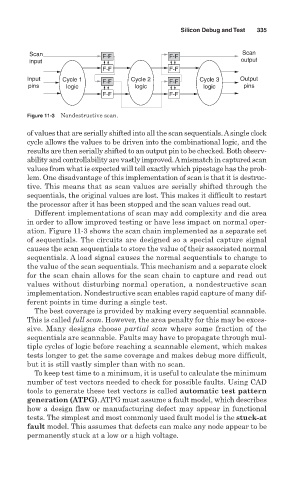
        Figure 11-3 Nondestructive scan.

        of values that are serially shifted into all the scan sequentials. Asingle clock
        cycle allows the values to be driven into the combinational logic, and the
        results are then serially shifted to an output pin to be checked. Both observ-
        ability and controllability are vastly improved. Amismatch in captured scan
        values from what is expected will tell exactly which pipestage has the prob-
        lem. One disadvantage of this implementation of scan is that it is destruc-
        tive. This means that as scan values are serially shifted through the
        sequentials, the original values are lost. This makes it difficult to restart
        the processor after it has been stopped and the scan values read out.
          Different implementations of scan may add complexity and die area
        in order to allow improved testing or have less impact on normal oper-
        ation. Figure 11-3 shows the scan chain implemented as a separate set
        of sequentials. The circuits are designed so a special capture signal
        causes the scan sequentials to store the value of their associated normal
        sequentials. A load signal causes the normal sequentials to change to
        the value of the scan sequentials. This mechanism and a separate clock
        for the scan chain allows for the scan chain to capture and read out
        values without disturbing normal operation, a nondestructive scan
        implementation. Nondestructive scan enables rapid capture of many dif-
        ferent points in time during a single test.
          The best coverage is provided by making every sequential scannable.
        This is called full scan. However, the area penalty for this may be exces-
        sive. Many designs choose partial scan where some fraction of the
        sequentials are scannable. Faults may have to propagate through mul-
        tiple cycles of logic before reaching a scannable element, which makes
        tests longer to get the same coverage and makes debug more difficult,
        but it is still vastly simpler than with no scan.
          To keep test time to a minimum, it is useful to calculate the minimum
        number of test vectors needed to check for possible faults. Using CAD
        tools to generate these test vectors is called automatic test pattern
        generation (ATPG). ATPG must assume a fault model, which describes
        how a design flaw or manufacturing defect may appear in functional
        tests. The simplest and most commonly used fault model is the stuck-at
        fault model. This assumes that defects can make any node appear to be
        permanently stuck at a low or a high voltage.

