


Page 364 - A Practical Guide from Design Planning to Manufacturing
P. 364
334   Chapter Eleven


                             F-F               F-F
        Input     Cycle 1           Cycle 2            Cycle 3    Output
         pins      logic             logic              logic      pins
                             F-F               F-F

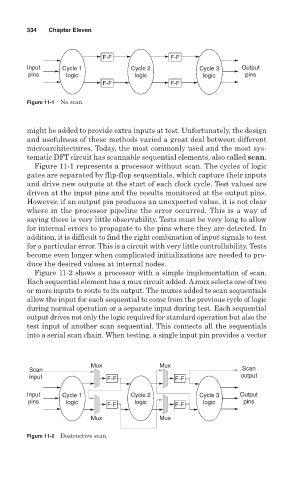
        Figure 11-1 No scan.


        might be added to provide extra inputs at test. Unfortunately, the design
        and usefulness of these methods varied a great deal between different
        microarchitectures. Today, the most commonly used and the most sys-
        tematic DFT circuit has scannable sequential elements, also called scan.
          Figure 11-1 represents a processor without scan. The cycles of logic
        gates are separated by flip-flop sequentials, which capture their inputs
        and drive new outputs at the start of each clock cycle. Test values are
        driven at the input pins and the results monitored at the output pins.
        However, if an output pin produces an unexpected value, it is not clear
        where in the processor pipeline the error occurred. This is a way of
        saying there is very little observability. Tests must be very long to allow
        for internal errors to propagate to the pins where they are detected. In
        addition, it is difficult to find the right combination of input signals to test
        for a particular error. This is a circuit with very little controllability. Tests
        become even longer when complicated initializations are needed to pro-
        duce the desired values at internal nodes.
          Figure 11-2 shows a processor with a simple implementation of scan.
        Each sequential element has a mux circuit added. Amux selects one of two
        or more inputs to route to its output. The muxes added to scan sequentials
        allow the input for each sequential to come from the previous cycle of logic
        during normal operation or a separate input during test. Each sequential
        output drives not only the logic required for standard operation but also the
        test input of another scan sequential. This connects all the sequentials
        into a serial scan chain. When testing, a single input pin provides a vector


                          Mux               Mux
         Scan                                                     Scan
         input                F-F               F-F               output
        Input     Cycle 1           Cycle 2            Cycle 3    Output
         pins      logic      F-F    logic      F-F     logic      pins
                          Mux               Mux

        Figure 11-2 Destructive scan.

