


Page 262 - Microtectonics
P. 262
254   9  ·  Natural Microgauges
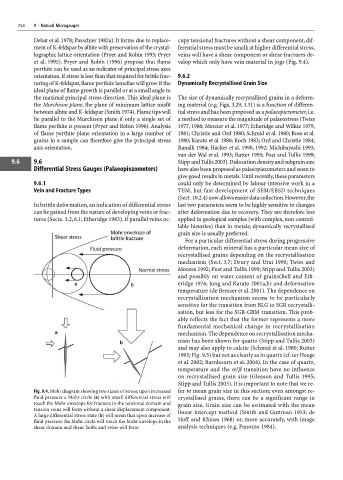
                   Debat et al. 1978; Passchier 1982a). It forms due to replace-  cupy tensional fractures without a shear component, dif-
                   ment of K-feldspar by albite with preservation of the crystal-  ferential stress must be small; at higher differential stress,
                   lographic lattice orientation (Pryer and Robin 1995; Pryer  veins will have a shear component or shear fractures de-
                   et al. 1995). Pryer and Robin (1996) propose that flame  velop which only have vein material in jogs (Fig. 9.4).
                   perthite can be used as an indicator of principal stress axes
                   orientation. If stress is less than that required for brittle frac-  9.6.2
                   turing of K-feldspar, flame perthite lamellae will grow if the  Dynamically Recrystallised Grain Size
                   ideal plane of flame growth is parallel or at a small angle to
                   the maximal principal stress direction. This ideal plane is  The size of dynamically recrystallised grains in a deform-
                   the Murchison plane, the plane of minimum lattice misfit  ing material (e.g. Figs. 3.29, 3.31) is a function of differen-
                   between albite and K-feldspar (Smith 1974). Flame tips will  tial stress and has been proposed as a palaeopiezometer, i.e.
                   lie parallel to the Murchison plane if only a single set of  a method to measure the magnitude of palaeostress (Twiss
                   flame perthite is present (Pryer and Robin 1996). Analysis  1977, 1986; Mercier et al. 1977; Etheridge and Wilkie 1979,
                   of flame perthite plane orientation in a large number of  1981; Christie and Ord 1980; Schmid et al. 1980; Ross et al.
                   grains in a sample can therefore give the principal stress  1980; Karato et al. 1980; Koch 1983; Ord and Christie 1984;
                   axis orientation.                            Ranalli 1984; Hacker et al. 1990, 1992; Michibayashi 1993;
                                                                van der Wal et al. 1993; Rutter 1995; Post and Tullis 1999;
           9.6     9.6                                          Stipp and Tullis 2003). Dislocation density and subgrain size
                   Differential Stress Gauges (Palaeopiezometers)  have also been proposed as palaeopiezometers and seem to
                                                                give good results in metals. Until recently, these parameters
                   9.6.1                                        could only be determined by labour-intensive work in a
                   Vein and Fracture Types                      TEM, but fast development of SEM/EBSD techniques
                                                                (Sect. 10.2.4) now allows easier data collection. However, the
                   In brittle deformation, an indication of differential stress  last two parameters seem to be highly sensitive to changes
                   can be gained from the nature of developing veins or frac-  after deformation due to recovery. They are therefore less
                   tures (Sects. 3.2, 6.1; Etheridge 1983). If parallel veins oc-  applied in geological samples (with complex, non-control-
                                                                lable histories) than in metals; dynamically recrystallised
                                                                grain size is usually preferred.
                                                                   For a particular differential stress during progressive
                                                                deformation, each mineral has a particular mean size of
                                                                recrystallised grains depending on the recrystallisation
                                                                mechanism (Sect. 3.7; Drury and Urai 1990; Twiss and
                                                                Moores 1992; Post and Tullis 1999; Stipp and Tullis 2003)
                                                                and possibly on water content of grains(Bell and Eth-
                                                                eridge 1976; Jung and Karato 2001a,b) and deformation
                                                                temperature (de Bresser et al. 2001). The dependence on
                                                                recrystallisation mechanism seems to be particularly
                                                                sensitive for the transition from BLG to SGR recrystalli-
                                                                sation, but less for the SGR-GBM transition. This prob-
                                                                ably reflects the fact that the former represents a more
                                                                fundamental mechanical change in recrystallisation
                                                                mechanism. The dependence on recrystallisation mecha-
                                                                nism has been shown for quartz (Stipp and Tullis 2003)
                                                                and may also apply to calcite (Schmid et al. 1980; Rutter
                                                                1995; Fig. 9.5) but not as clearly as in quartz (cf. ter Heege
                                                                et al. 2002; Barnhoorn et al. 2004). In the case of quartz,
                                                                temperature and the α/β transition have no influence
                                                                on recrystallised grain size (Gleason and Tullis 1995;
                                                                Stipp and Tullis 2003). It is important to note that we re-
                   Fig. 9.4. Mohr diagram showing two states of stress; upon increased  fer to mean grain size in this section; even amongst re-
                   fluid pressure a Mohr circle (a) with small differential stress will  crystallised grains, there can be a significant range in
                   touch the Mohr envelope for fracture in the tensional domain and  grain size. Grain size can be estimated with the mean
                   tension veins will form without a shear displacement component.
                   A large differential stress state (b) will mean that upon increase of  linear intercept method (Smith and Guttman 1953; de
                   fluid pressure the Mohr circle will touch the Mohr envelope in the  Hoff and Rhines 1968) or, more accurately, with image
                   shear domain and shear faults and veins will form  analysis techniques (e.g. Panozzo 1984).

