


Page 267 - Microtectonics
P. 267
9.9  ·  Temperature Gauges  259
                                                               ary diffusion rates are fully temperature dependent,
                                                               which is directly reflected by the spacing of the symplec-
                                                               tite (Shewmon 1969). Since the exsolved volume percent-
                                                               age of mineral B depends on the original composition of
                                                               mineral A, it is the combined width of a pair of lamellae
                                                               of A' and B that is critical, not their individual widths
                                                               (Fig. 9.9; van Roermund 1992). Good examples of exso-
                                                               lution symplectites can be found in retrogressed eclogites
                                                               in which the Na-bearing clinopyroxene becomes replaced
                                                               by clinopyroxene-plagioclase symplectites (Boland and
                                                               van Roermund 1983; van Roermund and Boland 1983).
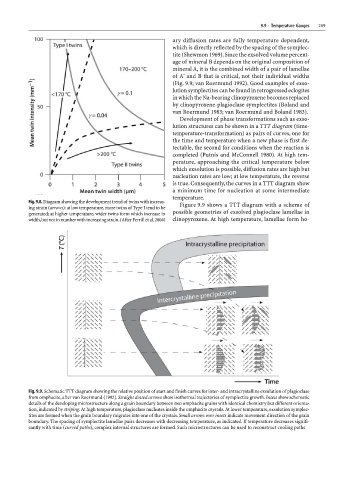
                                                                 Development of phase transformations such as exso-
                                                               lution structures can be shown in a TTT diagram (time-
                                                               temperature-transformation) as pairs of curves, one for
                                                               the time and temperature when a new phase is first de-
                                                               tectable, the second for conditions when the reaction is
                                                               completed (Putnis and McConnell 1980). At high tem-
                                                               perature, approaching the critical temperature below
                                                               which exsolution is possible, diffusion rates are high but
                                                               nucleation rates are low; at low temperature, the reverse
                                                               is true. Consequently, the curves in a TTT diagram show
                                                               a minimum time for nucleation at some intermediate
                                                               temperature.
                 Fig. 9.8. Diagram showing the development trend of twins with increas-  Figure 9.9 shows a TTT diagram with a scheme of
                 ing strain (arrows): at low temperature, more twins of Type I tend to be
                 generated; at higher temperature, wider twins form which increase in  possible geometries of exsolved plagioclase lamellae in
                 width, but not in number with increasing strain. (After Ferrill et al. 2004)  clinopyroxene. At high temperature, lamellae form ho-


                 Fig. 9.9. Schematic TTT diagram showing the relative position of start and finish curves for inter- and intracrystalline exsolution of plagioclase
                 from omphacite, after van Roermund (1992). Straight dotted arrows show isothermal trajectories of symplectite growth. Insets show schematic
                 details of the developing microstructure along a grain boundary between two omphacite grains with identical chemistry but different orienta-
                 tion, indicated by striping. At high temperature, plagioclase nucleates inside the omphacite crystals. At lower temperature, exsolution symplec-
                 tites are formed when the grain boundary migrates into one of the crystals. Small arrows over insets indicate movement direction of the grain
                 boundary. The spacing of symplectite lamellae pairs decreases with decreasing temperature, as indicated. If temperature decreases signifi-
                 cantly with time (curved paths), complex internal structures are formed. Such microstructures can be used to reconstruct cooling paths

