


Page 266 - Microtectonics
P. 266
258   9  ·  Natural Microgauges
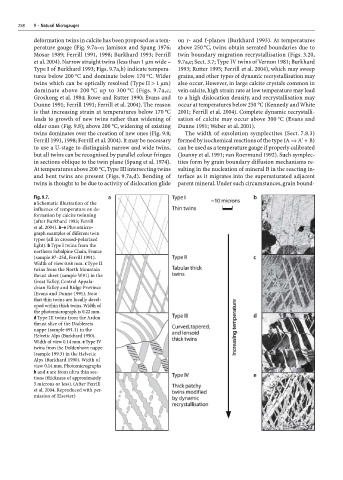
                   deformation twins in calcite has been proposed as a tem-  on r- and f-planes (Burkhard 1993). At temperatures
                   perature gauge (Fig. 9.7a–e; Jamison and Spang 1976;  above 250 °C, twins obtain serrated boundaries due to
                   Mosar 1989; Ferrill 1991, 1998; Burkhard 1993; Ferrill  twin boundary migration recrystallisation (Figs. 3.20,
                   et al. 2004). Narrow straight twins (less than 1 µm wide –  9.7a,e; Sect. 3.7; Type IV twins of Vernon 1981; Burkhard
                   Type I of Burkhard 1993; Figs. 9.7a,b) indicate tempera-  1993; Rutter 1995; Ferrill et al. 2004), which may sweep
                   tures below 200 °C and dominate below 170 °C. Wider  grains, and other types of dynamic recrystallisation may
                   twins which can be optically resolved (Type II > 1 µm)  also occur. However, in large calcite crystals common in
                   dominate above 200 °C up to 300 °C (Figs. 9.7a,c;  vein calcite, high strain rate at low temperature may lead
                   Groshong et al. 1984; Rowe and Rutter 1990; Evans and  to a high dislocation density, and recrystallisation may
                   Dunne 1991; Ferrill 1991; Ferrill et al. 2004). The reason  occur at temperatures below 250 °C (Kennedy and White
                   is that increasing strain at temperatures below 170 °C  2001; Ferrill et al. 2004). Complete dynamic recrystalli-
                   leads to growth of new twins rather than widening of  sation of calcite may occur above 300 °C (Evans and
                   older ones (Fig. 9.8); above 200 °C, widening of existing  Dunne 1991; Weber et al. 2001).
                   twins dominates over the creation of new ones (Fig. 9.8;  The width of exsolution symplectites (Sect. 7.8.3)
                   Ferrill 1991, 1998; Ferrill et al. 2004). It may be necessary  formed by isochemical reactions of the type (A ⇒ A' + B)
                   to use a U-stage to distinguish narrow and wide twins,  can be used as a temperature gauge if properly calibrated
                   but all twins can be recognised by parallel colour fringes  (Joanny et al. 1991; van Roermund 1992). Such symplec-
                   in sections oblique to the twin plane (Spang et al. 1974).  tites form by grain boundary diffusion mechanisms re-
                   At temperatures above 200 °C, Type III intersecting twins  sulting in the nucleation of mineral B in the reacting in-
                   and bent twins are present (Figs. 9.7a,d). Bending of  terface as it migrates into the supersaturated adjacent
                   twins is thought to be due to activity of dislocation glide  parent mineral. Under such circumstances, grain bound-

                   Fig. 9.7.
                   a Schematic illustration of the
                   influence of temperature on de-
                   formation by calcite twinning
                   (after Burkhard 1993; Ferrill
                   et al. 2004). b–e Photomicro-
                   graph examples of different twin
                   types (all in crossed-polarized
                   light). b Type I twins from the
                   northern Subalpine Chain, France
                   (sample 87–25d, Ferrill 1991).
                   Width of view 0.68 mm. c Type II
                   twins from the North Mountain
                   thrust sheet (sample W91) in the
                   Great Valley, Central Appala-
                   chian Valley and Ridge Province
                   (Evans and Dunne 1991). Note
                   that thin twins are locally devel-
                   oped within thick twins. Width of
                   the photomicrograph is 0.22 mm.
                   d Type III twins from the Ardon
                   thrust slice of the Diablerets
                   nappe (sample 691.1) in the
                   Helvetic Alps (Burkhard 1990).
                   Width of view 0.14 mm. e Type IV
                   twins from the Doldenhorn nappe
                   (sample 199.3) in the Helvetic
                   Alps (Burkhard 1990). Width of
                   view 0.14 mm. Photomicrographs
                   b and c are from ultra thin sec-
                   tions (thickness of approximately
                   5 microns or less). (After Ferrill
                   et al. 2004. Reproduced with per-
                   mission of Elsevier)

