


Page 269 - Microtectonics
P. 269
9.10  ·  Rheology Gauges  261
                   LPO patterns can in many cases be used to determine
                 the active slip systems in crystals and indirectly tempera-
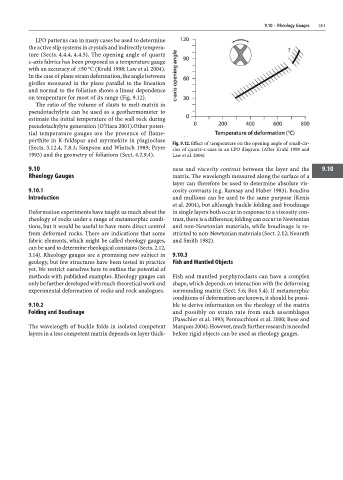
                 ture (Sects. 4.4.4, 4.4.5). The opening angle of quartz
                 c-axis fabrics has been proposed as a temperature gauge
                 with an accuracy of ±50 °C (Kruhl 1998; Law et al. 2004).
                 In the case of plane strain deformation, the angle between
                 girdles measured in the plane parallel to the lineation
                 and normal to the foliation shows a linear dependence
                 on temperature for most of its range (Fig. 9.12).
                   The ratio of the volume of clasts to melt-matrix in
                 pseudotachylyte can be used as a geothermometer to
                 estimate the initial temperature of the wall rock during
                 pseudotachylyte generation (O’Hara 2001).Other poten-
                 tial temperature gauges are the presence of flame-
                 perthite in K-feldspar and myrmekite in plagioclase  Fig. 9.12. Effect of temperature on the opening angle of small-cir-
                 (Sects. 3.12.4, 7.8.3; Simpson and Wintsch 1989; Pryer  cles of quartz-c-axes in an LPO diagram. (After Kruhl 1998 and
                 1993) and the geometry of foliations (Sect. 4.2.9.4).  Law et al. 2004)

                 9.10                                          ness and viscosity contrast between the layer and the  9.10
                 Rheology Gauges                               matrix. The wavelength measured along the surface of a
                                                               layer can therefore be used to determine absolute vis-
                 9.10.1                                        cosity contrasts (e.g. Ramsay and Huber 1983). Boudins
                 Introduction                                  and mullions can be used to the same purpose (Kenis
                                                               et al. 2004), but although buckle folding and boudinage
                 Deformation experiments have taught us much about the  in single layers both occur in response to a viscosity con-
                 rheology of rocks under a range of metamorphic condi-  trast, there is a difference; folding can occur in Newtonian
                 tions, but it would be useful to have more direct control  and non-Newtonian materials, while boudinage is re-
                 from deformed rocks. There are indications that some  stricted to non-Newtonian materials (Sect. 2.12; Neurath
                 fabric elements, which might be called rheology gauges,  and Smith 1982).
                 can be used to determine rheological constants (Sects. 2.12,
                 3.14). Rheology gauges are a promising new subject in  9.10.3
                 geology, but few structures have been tested in practice  Fish and Mantled Objects
                 yet. We restrict ourselves here to outline the potential of
                 methods with published examples. Rheology gauges can  Fish and mantled porphyroclasts can have a complex
                 only be further developed with much theoretical work and  shape, which depends on interaction with the deforming
                 experimental deformation of rocks and rock analogues.  surrounding matrix (Sect. 5.6; Box 5.4). If metamorphic
                                                               conditions of deformation are known, it should be possi-
                 9.10.2                                        ble to derive information on the rheology of the matrix
                 Folding and Boudinage                         and possibly on strain rate from such assemblages
                                                               (Passchier et al. 1993; Pennacchioni et al. 2000; Bose and
                 The wavelength of buckle folds in isolated competent  Marques 2004). However, much further research is needed
                 layers in a less competent matrix depends on layer thick-  before rigid objects can be used as rheology gauges.

