


Page 271 - Microtectonics
P. 271
264   10  ·  Special Techniques
           10.1    10.1                                         10.2
                   Introduction                                 Techniques to Study Deformation Fabrics

                   The study of microstructures in thin section can give a  10.2.1
                   lot of information for thematic and tectonic studies but  Cathodoluminescence
                   has its limitations. In many cases, additional informa-
                   tion has to be gathered by other techniques. In this chap-  Many minerals show luminescence when being excited
                   ter we wish to give the reader an outline of some other  with a beam of electrons. The impact of a primary elec-
                   analytical laboratory techniques that use minerals in their  tron beam on a sample causes processes like backscatter-
                   original arrangement in the rock, similar to that in a thin  ing of electrons, energy transfer to the lattice resulting
                   section, excluding techniques that use powdered or dis-  in local heating, and the generation of X-rays and sec-
                   solved rocks or minerals for analysis. Analysis may con-  ondary electrons. The latter are low enough in energy to
                   cern the fabric, the arrangement of minerals in the rock,  transfer electrons of lattice ions to an excited energetic
                   the mineral chemistry and isotope composition, fluid  state. The return of ions from the excited to the basic
                   inclusions, age of minerals and parts of minerals and lat-  state may cause a portion of the initial energy to be emit-
                   tice preferred orientation. We only discuss methods that  ted as light photons in the visible range of the electro-
                   study minerals in their original arrangement in the rock.  magnetic spectrum (Figs. 5.1b, 10.1, 10.9a). Because elec-
                   We indicate what problems can be studied by these tech-  tron beams are commonly produced in cathodes, this
                   niques, which type of materials can be studied and what  type of electron beam-induced luminescence is referred
                   type of sample is needed, and, finally, what the limita-  to as cathodoluminescence (CL). One characteristic of CL
                   tions of the different techniques are. The aim is to allow  is that the excited location and the location from which
                   the reader to assess whether other techniques can help  the CL is emitted may be several micrometres apart. As a
                   him to solve his problem and, if so, what material has to  result, CL images commonly have a somewhat blurred
                   be prepared.                                 or “out-of-focus” appearance when compared with
                                                                backscattered electron images (Sect. 10.2.4.3).
                                                                   The CL signal emitted by an excited mineral is mostly
                     Finally a warning: it is not difficult to obtain data
                                                                complex in nature. The emission can be related to the min-
                     using unfamiliar techniques, but it is difficult to in-
                                                                eral structure itself and this type of CL is mostly in the ul-
                     terpret the reliability of such data in any specific
                     geological setting.                        traviolet part of the spectrum. However, CL of many rock-
                                                                forming minerals is mainly controlled by the presence of
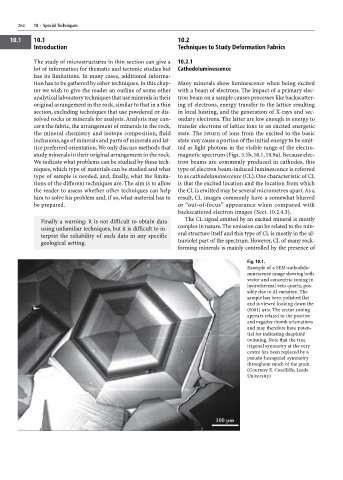
                                                                                       Fig. 10.1.
                                                                                       Example of a SEM-cathodolu-
                                                                                       minescence image showing both
                                                                                       sector and concentric zoning in
                                                                                       hydrothermal vein quartz, pos-
                                                                                       sibly due to Al variation. The
                                                                                       sample has been polished flat
                                                                                       and is viewed looking down the
                                                                                       (0001) axis. The sector zoning
                                                                                       appears related to the positive
                                                                                       and negative rhomb orientations
                                                                                       and may therefore have poten-
                                                                                       tial for indicating dauphiné
                                                                                       twinning. Note that the true
                                                                                       trigonal symmetry at the very
                                                                                       centre has been replaced by a
                                                                                       pseudo-hexagonal symmetry
                                                                                       throughout much of the grain.
                                                                                       (Courtesy E. Condliffe, Leeds
                                                                                       University)

