


Page 268 - Microtectonics
P. 268
260   9  ·  Natural Microgauges
                   mogeneously distributed inside the clinopyroxene crys-  recrystallisation. The transition of brittle to ductile de-
                   tals, but at lower temperature exsolution symplectites are  formation depends also on other factors (Sect. 3.14) but
                   formed at grain boundaries. Curved paths in tempera-  mostly on strain rate; with increasing strain rate, the tem-
                   ture-time space can give rise to unique microstructures  perature at which crystalplastic deformation starts in-
                   (Fig. 9.9), which can help to reconstruct P-T-t paths. Ob-  creases. Nevertheless, rough guidelines can be given for
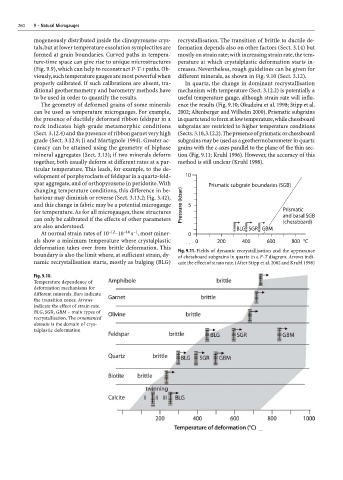
                   viously, such temperature gauges are most powerful when  different minerals, as shown in Fig. 9.10 (Sect. 3.12).
                   properly calibrated. If such calibrations are absent, tra-  In quartz, the change in dominant recrystallisation
                   ditional geothermometry and barometry methods have  mechanism with temperature (Sect. 3.12.2) is potentially a
                   to be used in order to quantify the results.  useful temperature gauge, although strain rate will influ-
                     The geometry of deformed grains of some minerals  ence the results (Fig. 9.10; Okudaira et al. 1998; Stipp et al.
                   can be used as temperature microgauges. For example,  2002; Altenberger and Wilhelm 2000). Prismatic subgrains
                   the presence of ductilely deformed ribbon feldspar in a  in quartz tend to form at low temperature, while chessboard
                   rock indicates high-grade metamorphic conditions  subgrains are restricted to higher temperature conditions
                   (Sect. 3.12.4) and the presence of ribbon garnet very high  (Sects. 3.10, 3.12.2). The presence of prismatic or chessboard
                   grade (Sect. 3.12.9; Ji and Martignole 1994). Greater ac-  subgrains may be used as a geothermobarometer in quartz
                   curacy can be attained using the geometry of biphase  grains with the c-axes parallel to the plane of the thin sec-
                   mineral aggregates (Sect. 3.13); if two minerals deform  tion (Fig. 9.11; Kruhl 1996). However, the accuracy of this
                   together, both usually deform at different rates at a par-  method is still unclear (Kruhl 1998).
                   ticular temperature. This leads, for example, to the de-
                   velopment of porphyroclasts of feldspar in a quartz-feld-
                   spar aggregate, and of orthopyroxene in peridotite. With
                   changing temperature conditions, this difference in be-
                   haviour may diminish or reverse (Sect. 3.13.2; Fig. 3.42),
                   and this change in fabric may be a potential microgauge
                   for temperature. As for all microgauges, these structures
                   can only be calibrated if the effects of other parameters
                   are also understood.
                                                  s , most miner-
                     At normal strain rates of 10 –12 –10 –14 –1
                   als show a minimum temperature where crystalplastic
                   deformation takes over from brittle deformation. This  Fig. 9.11. Fields of dynamic recrystallisation and the appearance
                   boundary is also the limit where, at sufficient strain, dy-  of chessboard subgrains in quartz in a P-T diagram. Arrows indi-
                   namic recrystallisation starts, mostly as bulging (BLG)  cate the effect of strain rate. (After Stipp et al. 2002 and Kruhl 1998)
                   Fig. 9.10.
                   Temperature dependence of
                   deformation mechanisms for
                   different minerals. Bars indicate
                   the transition zones. Arrows
                   indicate the effect of strain rate.
                   BLG, SGR, GBM – main types of
                   recrystallisation. The ornamented
                   domain is the domain of crys-
                   talplastic deformation

