


Page 273 - Microtectonics
P. 273
266   10  ·  Special Techniques
                                                                10.2.3
                                                                Electron Microscopy – Introduction

                                                                At magnifications exceeding 1000 ×, objects seen by the
                                                                optical microscope become fuzzy. This is a direct conse-
                                                                quence of the use of light as a medium to transport in-
                                                                formation; the wavelength of visible light varies from 400
                                                                to 750 nm and no objects smaller than 100 nm can be
                                                                observed. Depending on their velocity, electrons have
                                                                much smaller wavelengths and can therefore be used to
                                                                carry information about smaller objects. Two types of
                                                                electron microscope are commonly used in geology; the
                                                                scanning electron microscope (SEM), and the transmis-
                                                                sion electron microscope (TEM).

                                                                10.2.4
                                                                Scanning Electron Microscopy (SEM)
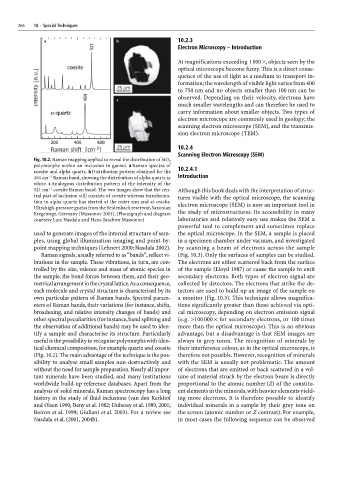
                   Fig. 10.2. Raman mapping applied to reveal the distribution of SiO 2
                   polymorphs within an inclusion in garnet. a Raman spectra of
                   coesite and alpha quartz. b Distribution pattern obtained for the  10.2.4.1
                       –1
                   464 cm  Raman band, showing the distribution of alpha quartz in  Introduction
                   white. c Analogous distribution pattern of the intensity of the
                       –1
                   521 cm  coesite Raman band. The two images show that the cen-  Although this book deals with the interpretation of struc-
                   tral part of inclusion still consists of coesite whereas transforma-  tures visible with the optical microscope, the scanning
                   tion to alpha quartz has started at the outer rim and at cracks.  electron microscope (SEM) is now an important tool in
                   Ultrahigh-pressure gneiss from the Seidenbach reservoir, Saxonian
                   Erzgebirge, Germany (Massonne 2001). (Photograph and diagram  the study of microstructures. Its accessibility in many
                   courtesy Lutz Nasdala and Hans-Joachim Massonne)  laboratories and relatively easy use makes the SEM a
                                                                powerful tool to complement and sometimes replace
                   used to generate images of the internal structure of sam-  the optical microscope. In the SEM, a sample is placed
                   ples, using global illumination imaging and point-by-  in a specimen chamber under vacuum, and investigated
                   point mapping techniques (Lehnert 2000; Nasdala 2002).  by scanning a beam of electrons across the sample
                     Raman signals, usually referred to as “bands”, reflect vi-  (Fig. 10.3). Only the surfaces of samples can be studied.
                   brations in the sample. These vibrations, in turn, are con-  The electrons are either scattered back from the surface
                   trolled by the size, valence and mass of atomic species in  of the sample (Lloyd 1987) or cause the sample to emit
                   the sample, the bond forces between them, and their geo-  secondary electrons. Both types of electron signal are
                   metrical arrangement in the crystal lattice. As a consequence,  collected by detectors. The electrons that strike the de-
                   each molecule and crystal structure is characterised by its  tectors are used to build up an image of the sample on
                   own particular pattern of Raman bands. Spectral param-  a monitor (Fig. 10.3). This technique allows magnifica-
                   eters of Raman bands, their variations (for instance, shifts,  tions significantly greater than those achieved via opti-
                   broadening, and relative intensity changes of bands) and  cal microscopy, depending on electron emission signal
                   other spectral peculiarities (for instance, band splitting and  (e.g. >100 000 × for secondary electrons, or 100 times
                   the observation of additional bands) may be used to iden-  more than the optical microscope). This is an obvious
                   tify a sample and characterise its structure. Particularly  advantage, but a disadvantage is that SEM images are
                   useful is the possibility to recognise polymorphs with iden-  always in grey tones. The recognition of minerals by
                   tical chemical composition, for example quartz and coesite  their interference colour, as in the optical microscope, is
                   (Fig. 10.2). The main advantage of the technique is the pos-  therefore not possible. However, recognition of minerals
                   sibility to analyse small samples non-destructively and  with the SEM is usually not problematic. The amount
                   without the need for sample preparation. Nearly all impor-  of electrons that are emitted or back scattered in a vol-
                   tant minerals have been studied, and many institutions  ume of material struck by the electron beam is directly
                   worldwide build-up reference databases. Apart from the  proportional to the atomic number (Z) of the constitu-
                   analysis of solid minerals, Raman spectroscopy has a long  ent elements in the minerals, with heavier elements yield-
                   history in the study of fluid inclusions (van den Kerkhof  ing more electrons. It is therefore possible to identify
                   and Olsen 1990; Beny et al. 1982; Dubessy et al. 1989, 2001;  individual minerals in a sample by their grey tone on
                   Boiron et al. 1999; Giuliani et al. 2003). For a review see  the screen (atomic number or Z contrast). For example,
                   Nasdala et al. (2001, 2004b).                in most cases the following sequence can be observed

