


Page 278 - Microtectonics
P. 278
10.2  ·  Techniques to Study Deformation Fabrics  271
                   which scatter at a small angle from lattice planes in a  in this way are known as electron channelling (EC)
                   crystal. Such a diffraction pattern carries all informa-  patterns and have a spatial resolution of >1–10 µm
                   tion necessary to determine the exact orientation of a  but an angular resolution of <1°. The angular spread
                   crystal with an error of less than 1°, provided the type  of EC patterns is typically <20°, which makes identi-
                   and composition of the mineral is known (Krieger-  fication relatively difficult (Fig. 10.8a).
                   Lassen 1996; Prior 1999). In order to find the crystal  3b. with the sample in the position for FSE-OC (i.e.
                   orientation from the pattern, the lines in the pattern  highly inclined), diffraction patterns can be ob-
                   must be indexed, i.e. the corresponding lattice planes  tained simply by focusing the incident electron
                   should be identified. There are two different methods  beam on a fixed position on the sample. The dif-
                   to obtain electron diffraction patterns:         fraction patterns produced in this way are known
                   3a. with the sample in the position for EC-OC (i.e. hori-  as electron backscattered diffraction (EBSD) pat-
                      zontal), diffraction patterns can be obtained if the  terns and have a spatial resolution of 0.1–1.5 µm
                      incident electron beam is focused on a fixed posi-  with an angular resolution of ~1°. The angular
                      tion on the sample and rocked back- and forward  spread of EBSD patterns is typically >50°, which
                      (Figs. 10.3, 10.8a). The diffraction patterns produced  makes identification relatively easy (Fig. 10.8b).

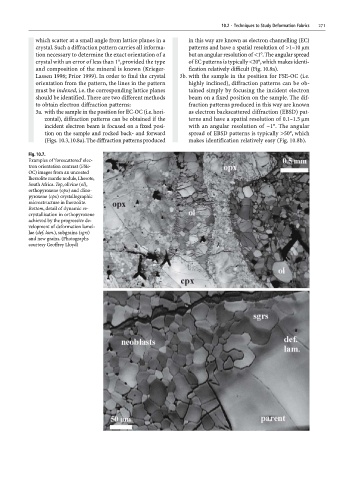
                 Fig. 10.7.
                 Examples of ‘forescattered’ elec-
                 tron orientation contrast (FSE-
                 OC) images from an uncoated
                 lherzolite mantle nodule, Lhesoto,
                 South Africa. Top, olivine (ol),
                 orthopyroxene (opx) and clino-
                 pyroxene (cpx) crystallographic
                 microstructure in lherzolite.
                 Bottom, detail of dynamic re-
                 crystallisation in orthopyroxene
                 achieved by the progressive de-
                 velopment of deformation lamel-
                 lae (def. lam.), subgrains (sgrs)
                 and new grains. (Photographs
                 courtesy Geoffrey Lloyd)

