


Page 276 - Microtectonics
P. 276
10.2  ·  Techniques to Study Deformation Fabrics  269
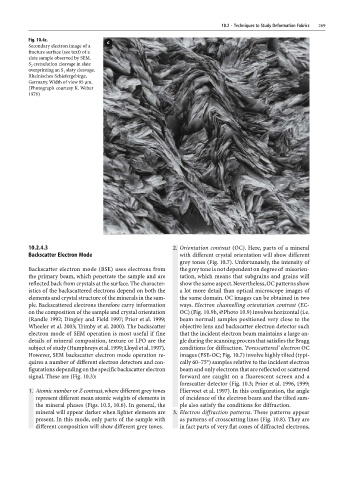
                 Fig. 10.4c.
                 Secondary electron image of a
                 fracture surface (see text) of a
                 slate sample observed by SEM.
                 S 2  crenulation cleavage in slate
                 overprinting an S  slaty cleavage.
                            1
                 Rheinisches Schiefergebirge,
                 Germany. Width of view 95 µm.
                 (Photograph courtesy K. Weber
                 1976)


                 10.2.4.3                                      2. Orientation contrast (OC). Here, parts of a mineral
                 Backscatter Electron Mode                       with different crystal orientation will show different
                                                                 grey tones (Fig. 10.7). Unfortunately, the intensity of
                 Backscatter electron mode (BSE) uses electrons from  the grey tone is not dependent on degree of  misorien-
                 the primary beam, which penetrate the sample and are  tation, which means that subgrains and grains will
                 reflected back from crystals at the surface. The character-  show the same aspect. Nevertheless, OC patterns show
                 istics of the backscattered electrons depend on both the  a lot more detail than optical microscope images of
                 elements and crystal structure of the minerals in the sam-  the same domain. OC images can be obtained in two
                 ple. Backscattered electrons therefore carry information  ways. Electron channelling orientation contrast (EC-
                 on the composition of the sample and crystal orientation  OC) (Fig. 10.9b, ×Photo 10.9) involves horizontal (i.e.
                 (Randle 1992; Dingley and Field 1997; Prior et al. 1999;  beam normal) samples positioned very close to the
                 Wheeler et al. 2003; Trimby et al. 2000). The backscatter  objective lens and backscatter electron detector such
                 electron mode of SEM operation is most useful if fine  that the incident electron beam maintains a large an-
                 details of mineral composition, texture or LPO are the  gle during the scanning process that satisfies the Bragg
                 subject of study (Humphreys et al. 1999; Lloyd et al. 1997).  conditions for diffraction. ‘Forescattered’ electron OC
                 However, SEM backscatter electron mode operation re-  images (FSE-OC; Fig. 10.7) involve highly tilted (typi-
                 quires a number of different electron detectors and con-  cally 60–75°) samples relative to the incident electron
                 figurations depending on the specific backscatter electron  beam and only electrons that are reflected or scattered
                 signal. These are (Fig. 10.3):                  forward are caught on a fluorescent screen and a
                                                                 forescatter detector (Fig. 10.3; Prior et al. 1996, 1999;
                 1. Atomic number or Z contrast, where different grey tones  Fliervoet et al. 1997). In this configuration, the angle
                   represent different mean atomic weights of elements in  of incidence of the electron beam and the tilted sam-
                   the mineral phases (Figs. 10.5, 10.6). In general, the  ple also satisfy the conditions for diffraction.
                   mineral will appear darker when lighter elements are  3. Electron diffraction patterns. These patterns appear
                   present. In this mode, only parts of the sample with  as patterns of crosscutting lines (Fig. 10.8). They are
                   different composition will show different grey tones.  in fact parts of very flat cones of diffracted electrons,

