


Page 263 - Microtectonics
P. 263
9.6  ·  Differential Stress Gauges (Palaeopiezometers)  255


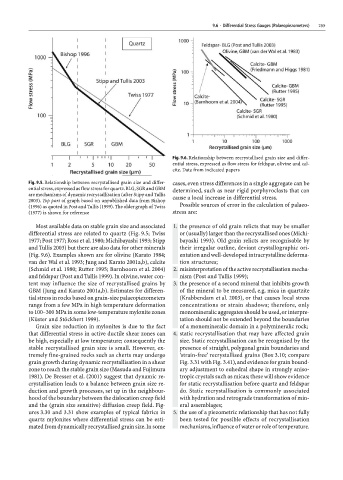
                                                               Fig. 9.6. Relationship between recrystallised grain size and differ-
                                                               ential stress, expressed as flow stress for feldspar, olivine and cal-
                                                               cite. Data from indicated papers

                 Fig. 9.5. Relationship between recrystallised grain size and differ-  cases, even stress differences in a single aggregate can be
                 ential stress, expressed as flow stress for quartz. BLG, SGR and GBM  determined, such as near rigid porphyroclasts that can
                 are mechanisms of dynamic recrystallisation (after Stipp and Tullis
                 2003). Top part of graph based on unpublished data from Bishop  cause a local increase in differential stress.
                 (1996) as quoted in Post and Tullis (1999). The older graph of Twiss  Possible sources of error in the calculation of palaeo-
                 (1977) is shown for reference                 stress are:
                   Most available data on stable grain size and associated  1. the presence of old grain relicts that may be smaller
                 differential stress are related to quartz (Fig. 9.5; Twiss  or (usually) larger than the recrystallised ones (Michi-
                 1977; Post 1977; Ross et al. 1980; Michibayashi 1993; Stipp  bayashi 1993). Old grain relicts are recognisable by
                 and Tullis 2003) but there are also data for other minerals  their irregular outline, deviant crystallographic ori-
                 (Fig. 9.6). Examples shown are for olivine (Karato 1984;  entation and well-developed intracrystalline deforma-
                 van der Wal et al. 1993; Jung and Karato 2001a,b), calcite  tion structures;
                 (Schmid et al. 1980; Rutter 1995; Barnhoorn et al. 2004)  2. misinterpretation of the active recrystallisation mecha-
                 and feldspar (Post and Tullis 1999). In olivine, water con-  nism (Post and Tullis 1999);
                 tent may influence the size of recrystallised grains by  3. the presence of a second mineral that inhibits growth
                 GBM (Jung and Karato 2001a,b). Estimates for differen-  of the mineral to be measured, e.g. mica in quartzite
                 tial stress in rocks based on grain-size palaeopiezometers  (Krabbendam et al. 2003), or that causes local stress
                 range from a few MPa in high temperature deformation  concentrations or strain shadows; therefore, only
                 to 100–300 MPa in some low-temperature mylonite zones  monomineralic aggregates should be used, or interpre-
                 (Küster and Stöckhert 1999).                    tation should not be extended beyond the boundaries
                   Grain size reduction in mylonites is due to the fact  of a monomineralic domain in a polymineralic rock;
                 that differential stress in active ductile shear zones can  4. static recrystallisation that may have affected grain
                 be high, especially at low temperature; consequently the  size. Static recrystallisation can be recognised by the
                 stable recrystallised grain size is small. However, ex-  presence of straight, polygonal grain boundaries and
                 tremely fine-grained rocks such as cherts may undergo  ‘strain-free’ recrystallised grains (Box 3.10; compare
                 grain growth during dynamic recrystallisation in a shear  Fig. 3.31 with Fig. 3.41), and evidence for grain bound-
                 zone to reach the stable grain size (Masuda and Fujimura  ary adjustment to euhedral shape in strongly aniso-
                 1981). De Bresser et al. (2001) suggest that dynamic re-  tropic crystals such as micas; these will show evidence
                 crystallisation leads to a balance between grain size re-  for static recrystallisation before quartz and feldspar
                 duction and growth processes, set up in the neighbour-  do. Static recrystallisation is commonly associated
                 hood of the boundary between the dislocation creep field  with hydration and retrograde transformation of min-
                 and the (grain size sensitive) diffusion creep field. Fig-  eral assemblages;
                 ures 3.30 and 3.31 show examples of typical fabrics in  5. the use of a piezometric relationship that has not fully
                 quartz mylonites where differential stress can be esti-  been tested for possible effects of recrystallisation
                 mated from dynamically recrystallised grain size. In some  mechanisms, influence of water or role of temperature.

