


Page 178 - MODELING OF ASPHALT CONCRETE
P. 178
156    Cha pte r  S i x


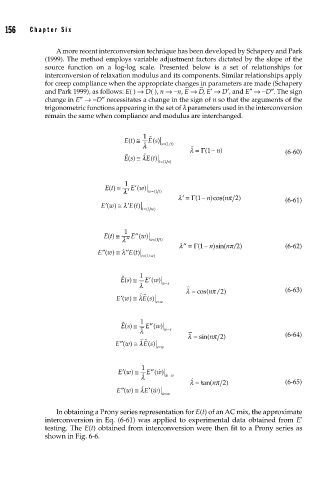
                       A more recent interconversion technique has been developed by Schapery and Park
                    (1999). The method employs variable adjustment factors dictated by the slope of the
                    source function on a log-log scale. Presented below is a set of relationships for
                    interconversion of relaxation modulus and its components. Similar relationships apply
                    for creep compliance when the appropriate changes in parameters are made (Schapery
                                                                ∼
                                                            ∼
                    and Park 1999), as follows: E( ) → D( ), n → −n, E → D, E′ → D′, and E″ → −D″. The sign
                    change in E″ → −D″ necessitates a change in the sign of n so that the arguments of the
                    trigonometric functions appearing in the set of l parameters used in the interconversion
                    remain the same when compliance and modulus are interchanged.


                                           Et() ≅  1  E s)
                                                   (

                                                λ    s (/
                                                      =
                                                       1
                                                        t)
                                                                     n
                                                             λ = Γ(1 − )                (6-60)


                                           Es () ≅ λ E t ( )
                                                    t (1
                                                     =
                                                       s)
                                              ( ′
                                     Et() ≅  1  E w)
                                            ′ λ  w (1  t)
                                                  =
                                                          λ ′ = Γ(1 − )cos(n  n π 2 )   (6-61)
                                     ′ Ew() ≅ ′E t( )λ
                                                t =(1  w)
                                               ( ′′
                                     Et() ≅  1  E w)
                                                   =
                                          λ ′′    w (1  t)      λ ′′ = Γ(1  − )sin(n  n π/ )     (6-62)
                                                                          2
                                   Ew   ≅ ′′E t( )λ
                                    ′′()
                                                 1
                                                = t (/ w)

                                          Es () ≅  1   E w)
                                                  ( ′
                                                      =
                                               λ     ws
                                                                      2
                                                            λ = cos(n π/ )              (6-63)
                                          ′ Ew()  ≅ E s( )λ
                                                    = sw

                                                   ( ′′
                                          Es () ≅  1  E w)
                                                       =
                                               λ      ws      λ = sin(n π 2 )           (6-64)
                                         ′′()
                                        Ew   ≅ E s( )λ
                                                    = sw
                                          ′ Ew() ≅  1 	  E ′′ w() 	  ww
                                                       =

                                               λ
                                                             λ = tan(n π 2 )            (6-65)

                                                 ′
                                          ′′() λ
                                        Ew    ≅ E w()
                                                      =

                                                     ww
                       In obtaining a Prony series representation for E(t) of an AC mix, the approximate
                                                                                            *
                    interconversion in Eq. (6-61) was applied to experimental data obtained from E
                    testing. The E(t) obtained from interconversion were then fit to a Prony series as
                    shown in Fig. 6-6.

