


Page 177 - MODELING OF ASPHALT CONCRETE
P. 177
Interr elationships among Asphalt Concr ete Stif fnesses   155


                    Approximate Analytical Methods
                    Numerous approximate analytical interconversion methods with different bases,
                    simplifications, assumptions, and accuracies have been proposed by Tschoegl (1989),
                    Schapery (1962), and Park et al. (1996), and others. Methods of primary interest are
                    those that have been widely used by asphalt researchers to relate between the time,
                    frequency, and Laplace domain representations of modulus and compliance.
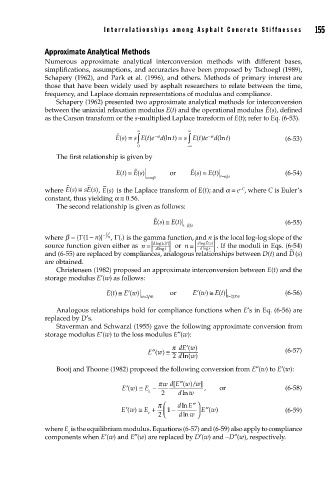
                       Schapery (1962) presented two approximate analytical methods for interconversion

                    between the uniaxial relaxation modulus E(t) and the operational modulus Es( ), defined
                    as the Carson transform or the s-multiplied Laplace transform of E(t); refer to Eq. (6-53).

                                              ∞              ∞

                                                             ∫
                                              ∫
                                                                  −
                                                   −
                                                ()
                                                    st
                                                               ()
                                                                   st
                                                                       t
                                        Es ( ) ≡  s E t e d(ln t) =  s E t te d(lnt)    (6-53)
                                              0             −∞
                       The first relationship is given by


                                        Et() ≅  E s)    or   Es () ≅  E t ( )           (6-54)
                                              (
                                                 s=α  t               t=α  s

                    where Es() ≡  sE s(), Es()  is the Laplace transform of E(t); and a = e , where C is Euler’s
                                                                           −C
                    constant, thus yielding a ≅ 0.56.

                       The second relationship is given as follows:

                                                   Es () ≅  E t ( )                     (6-55)
                                                           t=β  s
                                  n
                    where β = {(Γ 1 − )} − 1 n , Γ(.) is the gamma function, and n is the local log-log slope of the
                                                                  (
                    source function given either as  n ≡  dlog E t)   or  n ≡  dlog   E s)  . If the moduli in Eqs. (6-54)
                                                      (
                                                   dlog  t      dlog  s                  ∼
                    and (6-55) are replaced by compliances, analogous relationships between D(t) and D(s)
                    are obtained.
                       Christensen (1982) proposed an approximate interconversion between E(t) and the
                    storage modulus E′(w) as follows:
                                          E w)
                                      Et() ≅ ′ (      or    ′ Ew()  ≅ E t( )            (6-56)
                                               w=2 π t                  = t 2 π w
                       Analogous relationships hold for compliance functions when E′s in Eq. (6-56) are
                    replaced by D′s.
                       Staverman and Schwarzl (1955) gave the following approximate conversion from
                    storage modulus E′(w) to the loss modulus E″(w):
                                                        π  dE ()
                                                            ′ w
                                                 Ew   ≅                                 (6-57)
                                                  ′′()
                                                        2  dln( w)
                       Booij and Thoone (1982) proposed the following conversion from E″(w) to E′(w):
                                                    π w  dE [  ′′( )/ ]
                                                            ww
                                           ′ E ()w  ≅ E  −       ,  or                  (6-58)
                                                 e   2    dlnw
                                                    π ⎛   dln E ′′ ⎞
                                           ()
                                                                  ′′()
                                           ′ Ew  ≅ E e  +  ⎜ 1  −  ⎟  Ew                (6-59)
                                                    2  ⎝  dln w  ⎠
                    where E  is the equilibrium modulus. Equations (6-57) and (6-59) also apply to compliance
                           e
                    components when E′(w) and E″(w) are replaced by D′(w) and −D″(w), respectively.

