


Page 176 - MODELING OF ASPHALT CONCRETE
P. 176
154    Cha pte r  S i x


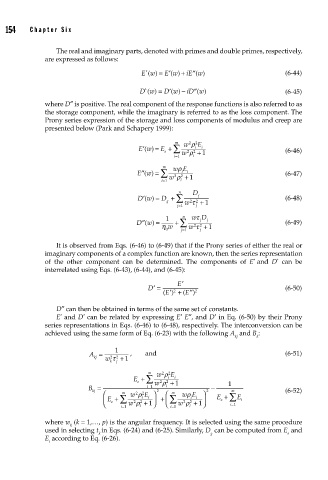
                       The real and imaginary parts, denoted with primes and double primes, respectively,
                    are expressed as follows:
                                                              ′′
                                                      E w +
                                                 *
                                                               ()
                                                 ()
                                               Ew ≡ ′   ()  iE w                        (6-44)
                                                              ′′
                                                       ′
                                                *
                                                        ()
                                               Dw ≡   D w −  iD w                       (6-45)
                                                               ()
                                                 ()
                    where D″ is positive. The real component of the response functions is also referred to as
                    the storage component, while the imaginary is referred to as the loss component. The
                    Prony series expression of the storage and loss components of modulus and creep are
                    presented below (Park and Schapery 1999):
                                                           w ρ
                                                         m
                                                             2
                                                ′ Ew()  = E e  + ∑  w ρ 2 2 i  E i      (6-46)
                                                            2
                                                               + 1
                                                         = i 1  i
                                                          ρ
                                                     m
                                                        wE
                                              Ew   = ∑ w ρ 2 i  i                       (6-47)
                                               ′′()
                                                         2
                                                     = i 1  i  + 1
                                                          n
                                                              D
                                                ′()
                                              Dw   = D g  + ∑  w τ 2 j                  (6-48)
                                                             2
                                                          = j 1  j  + 1
                                                               τ
                                                           n
                                                                j
                                              Dw   =  1  + ∑  wD  j                     (6-49)
                                                ′′()
                                                     η w     w τ 2  + 1
                                                              2
                                                      0    = j 1  j
                       It is observed from Eqs. (6-46) to (6-49) that if the Prony series of either the real or
                    imaginary components of a complex function are known, then the series representation
                                                                                      *
                    of the other component can be determined. The components of E and  D  can be
                                                                               *
                    interrelated using Eqs. (6-43), (6-44), and (6-45):
                                                 D ′ =     ′ E                          (6-50)
                                                       ′ + E(
                                                      E () 2  ′′) 2
                       D″ can then be obtained in terms of the same set of constants.
                         *
                               *
                       E  and D  can be related by expressing E′   E″, and D′ in Eq. (6-50) by their Prony
                    series representations in Eqs. (6-46) to (6-48), respectively. The interconversion can be
                    achieved using the same form of Eq. (6-23) with the following A  and B :
                                                                          kj    k
                                        1
                                 A =        ,  and                                      (6-51)
                                  kj  w τ 2  + 1
                                       2
                                       k  j
                                                 m
                                                     2
                                             E + ∑  w ρ 2 i  E i
                                                      2
                                                     2
                                              e
                                B =              i=1  w ρ i  + 1   −    1
                                  kj                2             2      m              (6-52)
                                                            ρ
                                     ⎛    m  w ρ 2 E ⎞  ⎛  m  wE  ⎞  E +
                                              2
                                                                       +
                                                 i
                                     ⎜ ⎝ E + ∑ 1  w ρ 2 i  i  + 1 ⎠ ⎟  + ⎜ ⎝ ∑ 1  w ρ 2 i  i  + i  1 ⎠ ⎟  e ∑ E i
                                             2
                                                           2
                                                  1
                                       e
                                                                         = i 1
                                          i=
                                                        i=
                    where w  (k = 1,…, p) is the angular frequency. It is selected using the same procedure
                           k
                    used in selecting t in Eqs. (6-24) and (6-25). Similarly, D  can be computed from E  and
                                   k                               g                     e
                    E  according to Eq. (6-26).
                     i

