


Page 179 - MODELING OF ASPHALT CONCRETE
P. 179
Interr elationships among Asphalt Concr ete Stif fnesses   157


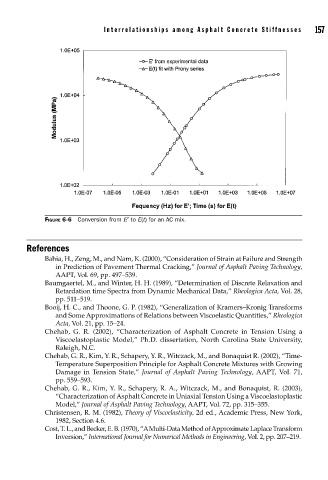
                    FIGURE 6-6  Conversion from E′ to E(t) for an AC mix.


               References
                    Bahia, H., Zeng, M., and Nam, K. (2000), “Consideration of Strain at Failure and Strength
                       in Prediction of Pavement Thermal Cracking,” Journal of Asphalt Paving Technology,
                       AAPT, Vol. 69, pp. 497–539.
                    Baumgaertel, M., and Winter, H. H. (1989), “Determination of Discrete Relaxation and
                       Retardation time Spectra from Dynamic Mechanical Data,” Rheologica Acta, Vol. 28,
                       pp. 511–519.
                    Booij, H. C., and Thoone, G. P. (1982), “Generalization of Kramers–Kronig Transforms
                       and Some Approximations of Relations between Viscoelastic Quantities,” Rheologica
                       Acta, Vol. 21, pp. 15–24.
                    Chehab, G. R. (2002), “Characterization of  Asphalt Concrete in Tension Using a
                       Viscoelastoplastic Model,” Ph.D. dissertation, North Carolina State University,
                       Raleigh, N.C.
                    Chehab, G. R., Kim, Y. R., Schapery, Y. R., Witczack, M., and Bonaquist R. (2002), “Time-
                       Temperature Superposition Principle for Asphalt Concrete Mixtures with Growing
                       Damage in Tension State,”  Journal of Asphalt Paving Technology, AAPT, Vol. 71,
                       pp. 559–593.
                    Chehab, G. R., Kim, Y. R., Schapery, R. A., Witczack, M., and Bonaquist, R. (2003),
                       “Characterization of Asphalt Concrete in Uniaxial Tension Using a Viscoelastoplastic
                       Model,” Journal of Asphalt Paving Technology, AAPT, Vol. 72, pp. 315–355.
                    Christensen, R. M. (1982), Theory of Viscoelasticity, 2d ed., Academic Press, New York,
                       1982, Section 4.6.
                    Cost, T. L., and Becker, E. B. (1970), “A Multi-Data Method of Approximate Laplace Transform
                       Inversion,” International Journal for Numerical Methods in Engineering, Vol. 2, pp. 207–219.

