


Page 174 - MODELING OF ASPHALT CONCRETE
P. 174
152    Cha pte r  S i x


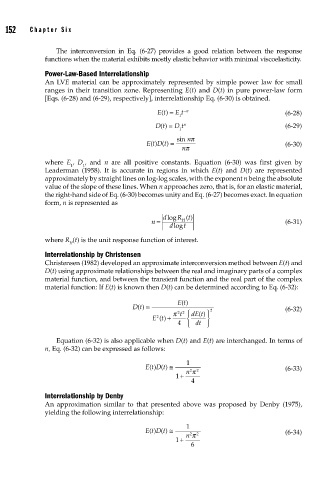
                       The interconversion in Eq. (6-27) provides a good relation between the response
                    functions when the material exhibits mostly elastic behavior with minimal viscoelasticity.

                    Power-Law-Based Interrelationship
                    An LVE material can be approximately represented by simple power law for small
                    ranges in their transition zone. Representing E(t) and D(t) in pure power-law form
                    [Eqs. (6-28) and (6-29), respectively], interrelationship Eq. (6-30) is obtained.
                                                     ()
                                                    Et = E t −  n                       (6-28)
                                                          1
                                                     ()
                                                   Dt = D t n                           (6-29)
                                                          1
                                                         sin  nπ
                                                 Et D t () =                            (6-30)
                                                  ()
                                                           nπ
                    where  E , D , and n  are all positive constants. Equation (6-30) was first given by
                            1  1
                    Leaderman (1958). It is accurate in regions in which  E(t) and  D(t) are represented
                    approximately by straight lines on log-log scales, with the exponent n being the absolute
                    value of the slope of these lines. When n approaches zero, that is, for an elastic material,
                    the right-hand side of Eq. (6-30) becomes unity and Eq. (6-27) becomes exact. In equation
                    form, n is represented as

                                                      dlog R t)
                                                            (
                                                  n =      H                            (6-31)
                                                       dlog t
                    where R (t) is the unit response function of interest.
                           H
                    Interrelationship by Christensen
                    Christensen (1982) developed an approximate interconversion method between E(t) and
                    D(t) using approximate relationships between the real and imaginary parts of a complex
                    material function, and between the transient function and the real part of the complex
                    material function: If E(t) is known then D(t) can be determined according to Eq. (6-32):

                                                          Et()
                                             Dt() ≅
                                                        π 22  dE t() ⎫ 2                (6-32)
                                                          t ⎧
                                                  Et() +    ⎨     ⎬
                                                    2
                                                          4  ⎩  dt  ⎭
                       Equation (6-32) is also applicable when D(t) and E(t) are interchanged. In terms of
                    n, Eq. (6-32) can be expressed as follows:
                                                            1
                                                  ()
                                                 Et D t() ≅  n π 2                      (6-33)
                                                             2
                                                         1 +
                                                             4
                    Interrelationship by Denby
                    An approximation similar to that presented above was proposed by Denby (1975),
                    yielding the following interrelationship:

                                                            1
                                                  ()
                                                 Et D t() ≅  n π 2                      (6-34)
                                                             2
                                                         1  +
                                                             6

