


Page 170 - MODELING OF ASPHALT CONCRETE
P. 170
148    Cha pte r  S i x


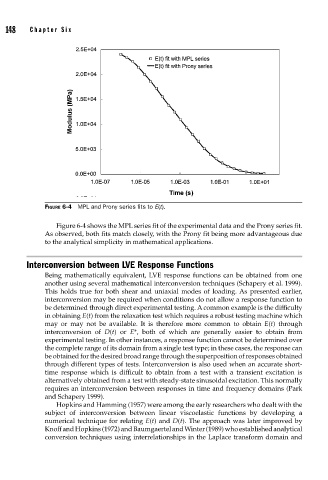
                    FIGURE 6-4  MPL and Prony series fi ts to E(t).

                       Figure 6-4 shows the MPL series fit of the experimental data and the Prony series fit.
                    As observed, both fits match closely, with the Prony fit being more advantageous due
                    to the analytical simplicity in mathematical applications.


               Interconversion between LVE Response Functions
                    Being mathematically equivalent, LVE response functions can be obtained from one
                    another using several mathematical interconversion techniques (Schapery et al. 1999).
                    This holds true for both shear and uniaxial modes of loading. As presented earlier,
                    interconversion may be required when conditions do not allow a response function to
                    be determined through direct experimental testing. A common example is the difficulty
                    in obtaining E(t) from the relaxation test which requires a robust testing machine which
                    may or may not be available. It is therefore more common to obtain  E(t) through
                    interconversion of  D(t) or  E*, both of which are generally easier to obtain from
                    experimental testing. In other instances, a response function cannot be determined over
                    the complete range of its domain from a single test type; in these cases, the response can
                    be obtained for the desired broad range through the superposition of responses obtained
                    through different types of tests. Interconversion is also used when an accurate short-
                    time response which is difficult to obtain from a test with a transient excitation is
                    alternatively obtained from a test with steady-state sinusoidal excitation. This normally
                    requires an interconversion between responses in time and frequency domains (Park
                    and Schapery 1999).
                       Hopkins and Hamming (1957) were among the early researchers who dealt with the
                    subject of interconversion between linear viscoelastic functions by developing a
                    numerical technique for relating E(t) and D(t). The approach was later improved by
                    Knoff and Hopkins (1972) and Baumgaertel and Winter (1989) who established analytical
                    conversion techniques using interrelationships in the Laplace transform domain and

