


Page 168 - MODELING OF ASPHALT CONCRETE
P. 168
146    Cha pte r  S i x


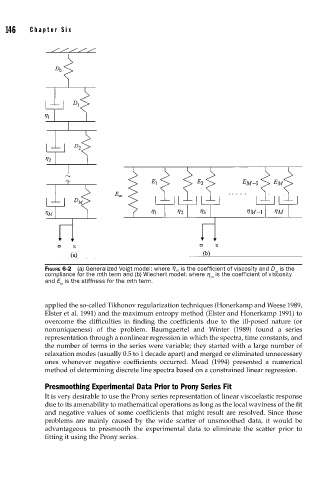
                    FIGURE 6-2  (a) Generalized Voigt model: where  h is the coeffi cient of viscosity and D  is the
                                                         m
                                                                                     m
                    compliance for the mth term and (b) Wiechert model: where h  is the coeffi cient of viscosity
                                                                   m
                    and E  is the stiffness for the mth term.
                        m
                    applied the so-called Tikhonov regularization techniques (Honerkamp and Weese 1989,
                    Elster et al. 1991) and the maximum entropy method (Elster and Honerkamp 1991) to
                    overcome the difficulties in finding the coefficients due to the ill-posed nature (or
                    nonuniqueness) of the problem. Baumgaertel and Winter (1989) found a series
                    representation through a nonlinear regression in which the spectra, time constants, and
                    the number of terms in the series were variable; they started with a large number of
                    relaxation modes (usually 0.5 to 1 decade apart) and merged or eliminated unnecessary
                    ones whenever negative coefficients occurred. Mead (1994) presented a numerical
                    method of determining discrete line spectra based on a constrained linear regression.
                    Presmoothing Experimental Data Prior to Prony Series Fit
                    It is very desirable to use the Prony series representation of linear viscoelastic response
                    due to its amenability to mathematical operations as long as the local waviness of the fit
                    and negative values of some coefficients that might result are resolved. Since those
                    problems are mainly caused by the wide scatter of unsmoothed data, it would be
                    advantageous to presmooth the experimental data to eliminate the scatter prior to
                    fitting it using the Prony series.

