


Page 169 - MODELING OF ASPHALT CONCRETE
P. 169
Interr elationships among Asphalt Concr ete Stif fnesses   147


                       As concluded previously, the power-law series provides a globally smooth and
                    broadband representation of the LVE response data. Its main drawback is the associated
                    analytical difficulty when conducting mathematical operations. However, the latter fact
                    does not eliminate the importance of power-law series as an ideal candidate to
                    presmooth the data to which a Prony series is subsequently fit. The resulting Prony
                    series fit to the presmoothed experimental data yields a smoother reconstructed curve
                    that is free of local waviness and that is analytically simple for mathematical operations.
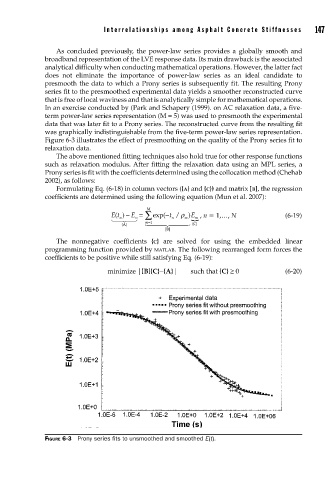
                    In an exercise conducted by (Park and Schapery (1999). on AC relaxation data, a five-
                    term power-law series representation (M = 5) was used to presmooth the experimental
                    data that was later fit to a Prony series. The reconstructed curve from the resulting fit
                    was graphically indistinguishable from the five-term power-law series representation.
                    Figure 6-3 illustrates the effect of presmoothing on the quality of the Prony series fit to
                    relaxation data.
                       The above mentioned fitting techniques also hold true for other response functions
                    such as relaxation modulus. After fitting the relaxation data using an MPL series, a
                    Prony series is fit with the coefficients determined using the collocation method (Chehab
                    2002), as follows:
                       Formulating Eq. (6-18) in column vectors ({A} and {C}) and matrix [B], the regression
                    coefficients are determined using the following equation (Mun et al. 2007):

                                              ∞ ∑
                                                             E
                                       Et () − E =  M  exp(− t / ρ  )E , n   1,…, N     (6-19)
                                                        n   m


                                                               m
                                         n
                                                m=1
                                          {A}                {C}
                                                      [B]
                       The nonnegative coefficients  {C} are solved for using the embedded linear
                    programming function provided by MATLAB. The following rearranged form forces the
                    coefficients to be positive while still satisfying Eq. (6-19):
                                      minimize |[B]{C}−{A}|  such that {C} ≥ 0          (6-20)


                    FIGURE 6-3  Prony series fi ts to unsmoothed and smoothed E(t).

