


Page 190 - Modern Derivatization Methods for Separation Sciences
P. 190
Document                                                                                Página 1 de 2


                                                                                                          Page 86

            20 ng. Davey et al. [116] showed a rapid and quantitative analytical method for cyanobacterial
            heterocyst type glycolipids. The type of glycolipids includes hydroxyalcohol or hydroxycarboxylic
            acid, which were derivatized with benzoyl chloride and analyzed NP-HPLC. Hawkins et al. [117]
            investigated the steric configuration of hydroxyeicosatetraenoates (HETEs) and other hydroxy fatty
            acids. The HETEs were derivatized with benzoyl or naphthoyl chloride following the methylation by
            diazomethane. The derivatives were purified by RP-HPLC and enantiomers were separated using a
            Pirkle type chiral stationary phase.

            Benzoyl Chloride Application: Determination of Alcohols in Human Serum [112]

            Serum sample (100 µ1) was mixed with 100 µ1 of 1,3-propanediol (500 mg/l, internal standard) and
            500 µ1 of 8 M NaOH. Benzoyl chloride (50 µ1) was added and the solution was incubated at ambient
            temperature for 5 min. The derivatizing reaction was terminated by adding 30 µ1 of 1% glycine. After
            purification by solid phase extraction, the derivatives were analyzed by C18 RP-HPLC within 8 min.
            The eluent was acetonitrile/water =1/1 with a flow rate of 2.5 ml/min. Detection was carried out at 237
            nm and the detection limit was 10 mg/1 serum, the calibration range was 20-2000 mg/l serum.
            Recovery of ethylene glycol addition in the serum was 96%. Within-run and between-run imprecision
            were less than 5% and 9.5% R.S.D. respectively.


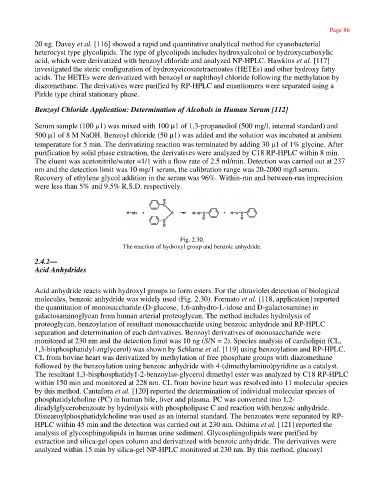
                                                          Fig. 2.30.
                                        The reaction of hydroxyl group and benzoic anhydride.

            2.4.2—
            Acid Anhydrides


            Acid anhydride reacts with hydroxyl groups to form esters. For the ultraviolet detection of biological
            molecules, benzoic anhydride was widely used (Fig. 2.30). Formato et al. [118, application] reported
            the quantitation of monosaccharide (D-glucose, 1,6-anhydro-L-idose and D-galactosamine) in
            galactosaminoglycan from human arterial proteoglycan. The method includes hydrolysis of
            proteoglycan, benzoylation of resultant monosaccharide using benzoic anhydride and RP-HPLC
            separation and determination of each derivatives. Benzoyl derivatives of monosaccharide were
            monitored at 230 nm and the detection limit was 10 ng (S/N = 2). Species analysis of cardiolipin (CL,
            1,3-bisphosphatidyl-snglycerol) was shown by Schlame et al. [119] using benzoylation and RP-HPLC.
            CL from bovine heart was derivatized by methylation of free phosphate groups with diazomethane
            followed by the benzoylation using benzoic anhydride with 4-(dimethylamino)pyridine as a catalyst.
            The resultant 1,3-bisphosphatidy1-2-benzoylsn-glycerol dimethyl ester was analyzed by C18 RP-HPLC
            within 150 min and monitored at 228 nm. CL from bovine heart was resolved into 11 molecular species
            by this method. Cantafora et al. [120] reported the determination of individual molecular species of
            phosphatidylcholine (PC) in human bile, liver and plasma. PC was converted into 1,2-
            diradylglycerobenzoate by hydrolysis with phospholipase C and reaction with benzoic anhydride.
            Distearoylphosphatidylcholine was used as an internal standard. The benzoates were separated by RP-
            HPLC within 45 min and the detection was carried out at 230 nm. Oshima et al. [121] reported the
            analysis of glycosphingolipids in human urine sediment. Glycosphingolipids were purified by
            extraction and silica-gel open column and derivatized with benzoic anhydride. The derivatives were
            analyzed within 15 min by silica-gel NP-HPLC monitored at 230 nm. By this method, glucosyl


            http://emedia.netlibrary.com/nlreader/nlreader.dll?bookid=17968&filename=Page_86.html     30/09/2003

