


Page 194 - Modern Derivatization Methods for Separation Sciences
P. 194
Document                                                                                Página 1 de 2


                                                                                                          Page 88

            RP-HPLC within 50 min and monitored at 240 nm. This method was applicable to the determination of
            endogenous levels of free inositol in the milk of cows, goats and humans. Rakotomanga et al. [124]
            investigated the method analyzing monosaccharide with phenylisocyanate derivatization. Derivatized
            monosaccharides were separated using RP-HPLC within 20 min. The detection limit of each
            monosaccharide at 240 nm was 0.2 ng. Determination of deoxysugars and methylglycosides were also
            performed by this method. Dethy et al. [125] showed a sensitive method of measuring polyols in
            biological samples by RP-HPLC. Sorbitol and galactitol in rat and human tissues were derivatized with
            phenylisocyanate and separated within 20 min. The detection limit at 240 nm was 3 ng. This method is
            applicable to estimate aldose reductase activity in various tissues.

            3,5-Dinitrophenyl isocyanate was also used to derivatize the hydroxyl group. Nakagawa et al. [126]
            reported chiral separation of hydroxy fatty acid using 3,5-dinitrophenyl isocyanate as a derivatizing
            reagent. Hydroxy fatty acids with various chain lengths and different positions of the hydroxyl group,
            were separated within 50 min by a HPLC with a chiral stationary phase. The derivatives were detected
            at 245 nm and the detection limit was 2.5 µg/ml. This method was applied to determine the optical
            configuration of 2 and 3 hydroxy fatty acids in bacterial lipids. Severini et al. [127] showed a
            stereospecific assay of methocarbamol, (R,S)-3-(2-methoxyphenoxy)1,2-propanediol-1-carbamate, in
            human plasma and urine. It is a skeletal muscle relaxant and was derivatized with (S)-(+)-1-(1-
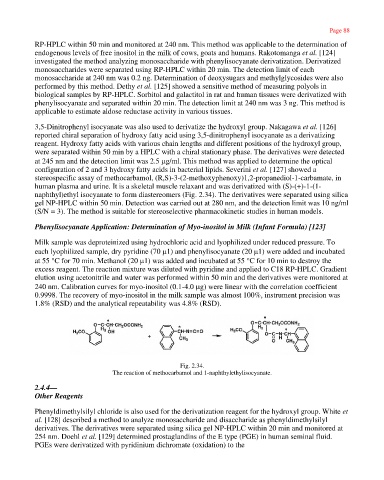
            naphthyl)ethyl isocyanate to form diastereomers (Fig. 2.34). The derivatives were separated using silica
            gel NP-HPLC within 50 min. Detection was carried out at 280 nm, and the detection limit was 10 ng/ml
            (S/N = 3). The method is suitable for stereoselective pharmacokinetic studies in human models.

            Phenylisocyanate Application: Determination of Myo-inositol in Milk (Infant Formula) [123]

            Milk sample was deproteinized using hydrochloric acid and lyophilized under reduced pressure. To
            each lyophilized sample, dry pyridine (70 µ1) and phenylisocyanate (20 µ1) were added and incubated
            at 55 °C for 70 min. Methanol (20 µ1) was added and incubated at 55 °C for 10 min to destroy the
            excess reagent. The reaction mixture was diluted with pyridine and applied to C18 RP-HPLC. Gradient
            elution using acetonitrile and water was performed within 50 min and the derivatives were monitored at
            240 nm. Calibration curves for myo-inositol (0.1-4.0 µg) were linear with the correlation coefficient
            0.9998. The recovery of myo-inositol in the milk sample was almost 100%, instrument precision was
            1.8% (RSD) and the analytical repeatability was 4.8% (RSD).


                                                          Fig. 2.34.
                                     The reaction of methocarbamol and 1-naphthylethylisocyanate.

            2.4.4—
            Other Reagents

            Phenyldimethylsilyl chloride is also used for the derivatization reagent for the hydroxyl group. White et
            al. [128] described a method to analyze monosaccharide and disaccharide as phenyldimethylsilyl
            derivatives. The derivatives were separated using silica gel NP-HPLC within 20 min and monitored at
            254 nm. Doehl et al. [129] determined prostaglandins of the E type (PGE) in human seminal fluid.
            PGEs were derivatized with pyridinium dichromate (oxidation) to the


            http://emedia.netlibrary.com/nlreader/nlreader.dll?bookid=17968&filename=Page_88.html     30/09/2003

