


Page 199 - Modern Derivatization Methods for Separation Sciences
P. 199
Document                                                                                Página 1 de 2


                                                                                                          Page 91

            were separated with CE-CZE (capillary zone electrophoresis) using borate buffer (pH 10.0) as a
            electrophoresis buffer. The detection was carried out at 291 nm and the detection limit was 170 fmol.
            Calibration range was 10-500 µg/ml. Rydlund et al. [134] showed an efficient CZE separation of wood-
            derived saccharides. Carbohydrates released from hemicellulose were derivatized with 6-
            aminoquinoline (6-AQ) and cyanoborohydride and separated by CE-CZE as borate complexes within
            15 min. Derivatives were monitored at 245 nm and the detection limit was in the few fmol range.

            Reductive Amination Application: Determination of Oligosaccharide Derivatized with N-(4-
            Aminobenzoyl)-L-glutamic Acid Using CE-CZE [133]

            An oligosaccharide sample (up to 2 mg/ml) was mixed with the derivatizing reagent solution (4% N-(4-
            aminobenzoyl)-L-glutamic acid 2% cyanoborohydride in 50% acetic acid). The mixture was heated at
            90 °C for 2-3 h. After cooling, the sample was diluted appropriately prior to electrophoresis. Separation
            of derivatized oligosaccharide was performed using CE-CZE with a fused silica capillary (75 µm i.d. ×
            70 cm). The electrophoresis buffer was a 200 mM borate buffer (pH 10.0) and detection was carried out
            at 291 nm. The detection limit of maltopentaose was 170 fmol and the calibration range was 10-500
            µg/ml.


            2.5.2—
            1-Phenyl-3-methyl-5-pyrazolone

            Honda et al. [135] reported a pre-column derivatization of mono and oligosaccharide using 1-phenyl-3-
            methyl-5-pyrazolone (PMP) as a reagent. The reagent reacts with reducing carbohydrates almost
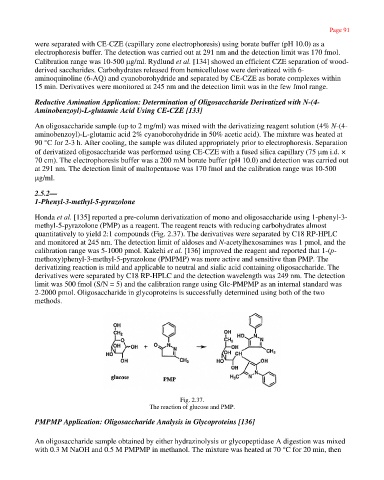
            quantitatively to yield 2:1 compounds (Fig. 2.37). The derivatives were separated by C18 RP-HPLC
            and monitored at 245 nm. The detection limit of aldoses and N-acetylhexosamines was 1 pmol, and the
            calibration range was 5-1000 pmol. Kakehi et al. [136] improved the reagent and reported that 1-(p-
            methoxy)phenyl-3-methyl-5-pyrazolone (PMPMP) was more active and sensitive than PMP. The
            derivatizing reaction is mild and applicable to neutral and sialic acid containing oligosaccharide. The
            derivatives were separated by C18 RP-HPLC and the detection wavelength was 249 nm. The detection
            limit was 500 fmol (S/N = 5) and the calibration range using Glc-PMPMP as an internal standard was
            2-2000 pmol. Oligosaccharide in glycoproteins is successfully determined using both of the two
            methods.


                                                          Fig. 2.37.
                                                 The reaction of glucose and PMP.

            PMPMP Application: Oligosaccharide Analysis in Glycoproteins [136]


            An oligosaccharide sample obtained by either hydrazinolysis or glycopeptidase A digestion was mixed
            with 0.3 M NaOH and 0.5 M PMPMP in methanol. The mixture was heated at 70 °C for 20 min, then


            http://emedia.netlibrary.com/nlreader/nlreader.dll?bookid=17968&filename=Page_91.html     30/09/2003

