


Page 196 - Modern Derivatization Methods for Separation Sciences
P. 196
Document                                                                                Página 1 de 2


                                                                                                          Page 89

            corresponding 15-oxoprostaglandins. The derivatives were separated by C18 RP-HPLC within 10 min
            and monitored at 230 nm.

            2.5—
            Label of Reducing Carbohydrate

            Carbohydrates have a reducing end in addition to the primary and secondary hydroxyl groups. To
            derivatize the reducing end of carbohydrates, reductive amination is widely used with various UV-
            absorbing amines, 1-phenyl-3methyl-5-pyrazolone as pre-column derivatizing reagents. Some post-
            column derivatizing reagents are also used.

            2.5.1—
            Reductive Amination

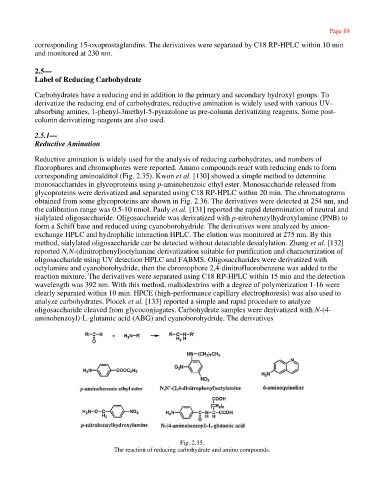
            Reductive amination is widely used for the analysis of reducing carbohydrates, and numbers of
            fluorophores and chromophores were reported. Amino compounds react with reducing ends to form
            corresponding aminoalditol (Fig. 2.35). Kwon et al. [130] showed a simple method to determine
            monosaccharides in glycoproteins using p-aminobenzoic ethyl ester. Monosaccharide released from
            glycoproteins were derivatized and separated using C18 RP-HPLC within 20 min. The chromatograms
            obtained from some glycoproteins are shown in Fig. 2.36. The derivatives were detected at 254 nm, and
            the calibration range was 0.5-10 nmol. Pauly et al. [131] reported the rapid determination of neutral and
            sialylated oligosaccharide. Oligosaccharide was derivatized with p-nitrobenzylhydroxylamine (PNB) to
            form a Schiff base and reduced using cyanoborohydride. The derivatives were analyzed by anion-
            exchange HPLC and hydrophilic interaction HPLC. The elution was monitored at 275 nm. By this
            method, sialylated oligosaccharide can be detected without detectable desialylation. Zhang et al. [132]
            reported N,N-(dinitrophenyl)octylamine derivatization suitable for purification and characterization of
            oligosaccharide using UV detection HPLC and FABMS. Oligosaccharides were derivatized with
            octylamine and cyanoborohydride, then the chromophore 2,4-dinitrofluorobenzene was added to the
            reaction mixture. The derivatives were separated using C18 RP-HPLC within 15 min and the detection
            wavelength was 392 nm. With this method, maltodextrins with a degree of polymerization 1-16 were
            clearly separated within 10 min. HPCE (high-performance capillary electrophoresis) was also used to
            analyze carbohydrates. Plocek et al. [133] reported a simple and rapid procedure to analyze
            oligosaccharide cleaved from glycoconjugates. Carbohydrate samples were derivatized with N-(4-
            aminobenzoyl)-L-glutamic acid (ABG) and cyanoborohydride. The derivatives


                                                          Fig. 2.35.
                                     The reaction of reducing carbohydrate and amino compounds.


            http://emedia.netlibrary.com/nlreader/nlreader.dll?bookid=17968&filename=Page_89.html     30/09/2003

