


Page 206 - Modern Spatiotemporal Geostatistics
P. 206
Modifications  of  BME  Analysis              187

        thus  offering  a measure of the  strength  and consistency of the association.  An
        exposure may not  be considered as a possible causal factor  if the vector  health-
        effect  predictions  provide  no improvement  in  the  rate  prediction  compared  to
        the  scalar  health-effect  predictions.
            The  quantitative  assessment  of  the  prediction  accuracy  of  Postulate  9.1
        can  be  made  in  terms  of  the  prediction  errors  at  a set  of  "control  points,"
        i.e.,  points  where the  actual  health effects  (e.g.,  death  rates)  are known and
        can  be  compared with  the  health-effect  predictions  obtained  from  scalar  vs.
        vector  BME  techniques.  Analysis of  an exposure-mortality association, e.g., is
        based on  the  successful prediction  of  mortality  at  a set of  control  points  using
        the  combined  exposure  (X)  and death-rate  (D)  data.  Providing  that  there
        are  no strong effects due to  hidden confounding factors,  an improved mortality
        prediction  obtained  from  the  combination  of  death  rate and exposure data as
        compared  to  that  obtained  merely  from  death-rate  data  should  support  the
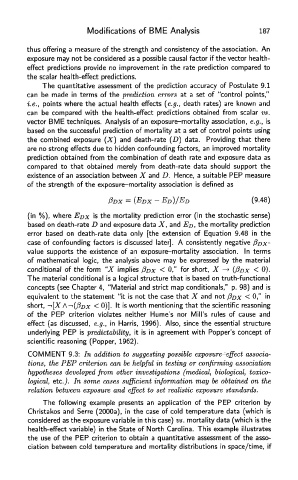
        existence of  an association between X  and D.  Hence, a suitable  PEP measure
        of  the  strength  of  the  exposure-mortality  association is defined as


        (in  %),  where EDX  is the  mortality  prediction  error  (in  the  stochastic  sense)
        based on death-rate D  and exposure data X,  and ED,  the mortality  prediction
        error  based  on  death-rate  data  only  [the  extension  of  Equation  9.48  in  the
        case  of  confounding  factors  is discussed later].  A  consistently  negative  PDX-
        value  supports  the  existence of  an  exposure-mortality  association.  In  terms
        of  mathematical  logic,  the  analysis above  may  be  expressed by the  material
        conditional  of the form  "X  implies  PDX  <  0,"  for short,  X  —»  (flux  <  0).
        The  material conditional  is a logical  structure that  is based on truth-functional
        concepts  (see Chapter 4,  "Material  and strict  map conditionals,"  p. 98)  and is
        equivalent  to  the statement  "it  is not the  case that X  and not Pox  <  0,"  in
        short,  -<[XI\~>(PDX  <  0)].  It is worth mentioning  that the scientific reasoning
        of  the  PEP  criterion  violates  neither  Hume's  nor  Mill's  rules  of  cause  and
        effect  (as  discussed,  e.g.,  in  Harris,  1996).  Also,  since the  essential structure
        underlying  PEP  is predictability,  it  is in  agreement with  Popper's concept  of
        scientific  reasoning (Popper,  1962).


        C O M M E N T  9.3: In addition   t o suggesting  possible  exposure-effect   associa-


        tions, the  PEP  criterion  canbe helpful in   testing   or   confirming  association


        hypotheses developed   from   other   investigations  (medical,   biological,   toxico-

        logical,  etc.J. In   some   cases   sufficient   information   may   be  obtained  on   the
        relation between  exposure  and   effect   to   set   realistic   exposure   standards.

            The  following  example  presents an  application  of  the  PEP  criterion  by
        Christakos  and  Serre  (2000a),  in  the  case  of  cold  temperature  data  (which  is
        considered as the exposure variable in this case)  vs. mortality data (which  is the
        health-effect  variable) in the  State of  North  Carolina. This  example  illustrates
        the  use of  the  PEP criterion  to  obtain  a quantitative  assessment  of  the  asso-
        ciation  between  cold  temperature  and mortality distributions  in space/time,  if

