


Page 123 - Modern physical chemistry
P. 123
114                        Relationships between Phases

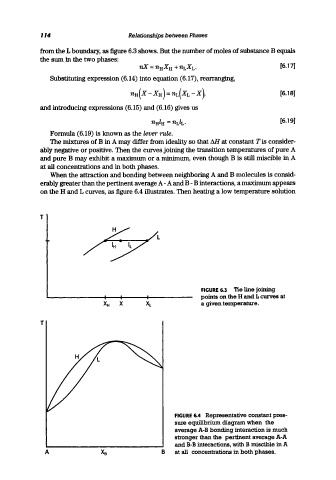
             from the L boundary, as figure 6.3 shows. But the number of moles of substance B equals
             the sum in the two phases:
                                           nX =nHXH  +nLXL.                          [6.17]
                Substituting expression (6.14) into equation (6.17), rearranging,
                                        nH(X -xH)=nL(XL -x),                         [6.18]


             and introducing expressions (6.15) and (6.16) gives us
                                                                                     [6.19]
                Formula (6.19) is known as the lever rule.
                The mixtures of B in A may differ from ideality so that MI at constant T is consider-
             ably negative or positive. Then the curves joining the transition temperatures of pure A
             and pure B may exhibit a maximum or a minimum, even though B is still miscible in A
             at all concentrations and in both phases.
                When the attraction and bonding between neighboring A and B molecules is consid-
             erably greater than the pertinent average A -A and B -B interactions, a maximum appears
             on the H and L curves, as figure 6.4 illustrates. Then heating a low temperature solution


             T


                                                L


                                                             FIGURE 6.3  Tie line joining
                                                             points on the H and L curves at
                                '4i   X                      a given temperature.


             T


                                                     FIGURE 6.4  Representative constant pres-
                                                     sure equilibrium diagram when  the
                                                     average A-B bonding interaction is much
                                                     stronger than the  pertinent average A-A
                                                     and B-B interactions, with B miscible in A
              A                                  B   at all  concentrations in both phases.

