


Page 204 - Modular design for machine tools
P. 204
164   Modular Design Guide and Machine Tools Description


                                                  F

                                                                     : Tool
                                                  10               T v
                                                                   W : Workpiece
                                                                    v
                                                                1 ~  14    : Structural
                                                                      modules

                       14
                T v  2    3    4   1    8    5    6    7   11   12   13   14  W v


                                                  7
                                                                    +
                                                                Note :        Common
                                                                     14
                                                (b)
               Figure 4-29    (Continued)

               pattern after the paths compatible with the design requirements are
               chosen. To simplify the design procedure, Lee proposed a design method
               whereby the module complexes are regarded as the entities (unit com-
               plexes) within the design data file such as files I and II in Fig. 4-30. In
               fact, the method of Lee can be considered as a forerunning trial of the
               platform proposed by Metternich and Würsching. Importantly, the con-
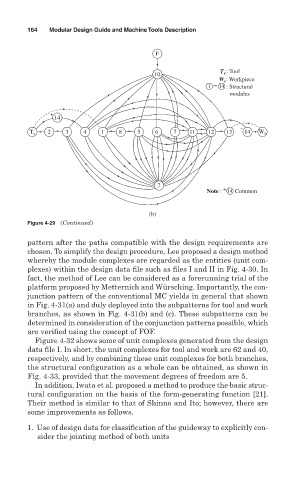
               junction pattern of the conventional MC yields in general that shown
               in Fig. 4-31(a) and duly deployed into the subpatterns for tool and work
               branches, as shown in Fig. 4-31(b) and (c). These subpatterns can be
               determined in consideration of the conjunction patterns possible, which
               are verified using the concept of FOF.
                 Figure 4-32 shows some of unit complexes generated from the design
               data file I. In short, the unit complexes for tool and work are 62 and 40,
               respectively, and by combining these unit complexes for both branches,
               the structural configuration as a whole can be obtained, as shown in
               Fig. 4-33, provided that the movement degrees of freedom are  5.
                 In addition, Iwata et al. proposed a method to produce the basic struc-
               tural configuration on the basis of the  form-generating function [21].
               Their method is similar to that of Shinno and Ito; however, there are
               some improvements as follows.

               1. Use of design data for classification of the guideway to explicitly con-
                  sider the jointing method of both units

