


Page 262 - Modular design for machine tools
P. 262
Engineering Design Fundamentals and Single Flat Joint Characteristics        221

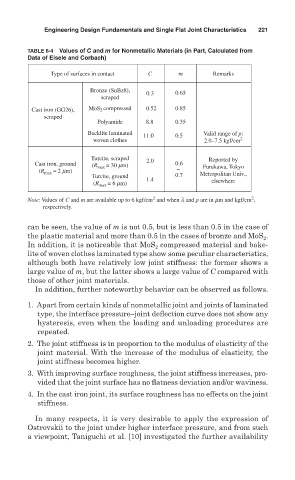
               TABLE 6-4 Values of C and m for Nonmetallic Materials (in Part, Calculated from
               Data of Eisele and Corbach)

                      Type of surfaces in contact  C    m        Remarks

                                Bronze (SnBz8),   0.3  0.65
                                   scraped
                Cast iron (GG26),   MoS 2 compressed  0.52  0.85
                    scraped
                                  Polyamide    8.8     0.35
                                Backlite laminated   11.0  0.5  Valid range of p:
                                 woven clothes                 2.0–7.5 kgf/cm 2

                                 Turcite, scraped               Reported by
                 Cast iron, ground   = 30 mm)  2.0     0.6
                                 (R max                        Furukawa, Tokyo
                  (R max = 2 mm)                        –
                                 Turcite, ground   1.4  0.7   Metropolitan Univ.,
                                 (R max  = 6 mm)                 elsewhere
                                                                            2
                                                 2
               Note: Values of C and m are available up to 6 kgf/cm  and when l and p are in mm and kgf/cm ,
                    respectively.
               can be seen, the value of m is not 0.5, but is less than 0.5 in the case of
               the plastic material and more than 0.5 in the cases of bronze and MoS 2 .
               In addition, it is noticeable that MoS 2 compressed material and bake-
               lite of woven clothes laminated type show some peculiar characteristics,
               although both have relatively low joint stiffness: the former shows a
               large value of m, but the latter shows a large value of C compared with
               those of other joint materials.
                 In addition, further noteworthy behavior can be observed as follows.

               1. Apart from certain kinds of nonmetallic joint and joints of laminated
                  type, the interface pressure–joint deflection curve does not show any
                  hysteresis, even when the loading and unloading procedures are
                  repeated.
               2. The joint stiffness is in proportion to the modulus of elasticity of the
                  joint material. With the increase of the modulus of elasticity, the
                  joint stiffness becomes higher.
               3. With improving surface roughness, the joint stiffness increases, pro-
                  vided that the joint surface has no flatness deviation and/or waviness.
               4. In the cast iron joint, its surface roughness has no effects on the joint
                  stiffness.

                 In many respects, it is very desirable to apply the expression of
               Ostrovskii to the joint under higher interface pressure, and from such
               a viewpoint, Taniguchi et al. [10] investigated the further availability

