


Page 263 - Modular design for machine tools
P. 263
222   Engineering Design for Machine Tool Joints

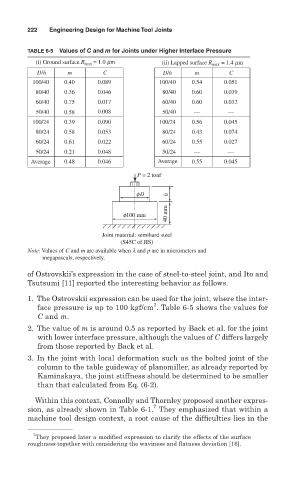
               TABLE 6-5 Values of C and m for Joints under Higher Interface Pressure
                                 = 1.0 mm
                  (i) Ground surface R max          (ii) Lapped surface R max  = 1.4 mm
                  D/h     m         C               D/h     m         C
                 100/40  0.40     0.089            100/40   0.54    0.051
                  80/40  0.36     0.046             80/40   0.60    0.039
                  60/40  0.75     0.017             60/40   0.60    0.032
                  50/40  0.58     0.008             50/40   —        —
                 100/24  0.39     0.090            100/24   0.56    0.045
                  80/24  0.58     0.053             80/24   0.43    0.074
                  60/24  0.61     0.022             60/24   0.55    0.027
                  50/24  0.21     0.048             50/24   —        —
                Average  0.48     0.046            Average  0.55    0.045
                                             P = 2 tonf

                                             fD      h

                                                     40 mm
                                         f100 mm

                                   Joint material: semihard steel
                                        (S45C of JIS)
               Note: Values of C and m are available when l and p are in micrometers and
                         megapascals, respectively.

               of Ostrovskii’s expression in the case of  steel-to-steel joint, and Ito and
               Tsutsumi [11] reported the interesting behavior as follows.

               1. The Ostrovskii expression can be used for the joint, where the inter-
                                                 2
                  face pressure is up to 100 kgf/cm . Table 6-5 shows the values for
                  C and m.
               2. The value of m is around 0.5 as reported by Back et al. for the joint
                  with lower interface pressure, although the values of C differs largely
                  from those reported by Back et al.
               3. In the joint with local deformation such as the bolted joint of the
                  column to the table guideway of planomiller, as already reported by
                  Kaminskaya, the joint stiffness should be determined to be smaller
                  than that calculated from Eq. (6-2).

                 Within this context, Connolly and Thornley proposed another expres-
                                                 7
               sion, as already shown in Table 6-1. They emphasized that within a
               machine tool design context, a root cause of the difficulties lies in the

                 7
                  They proposed later a modified expression to clarify the effects of the surface
               roughness together with considering the waviness and flatness deviation [16].

